
RC Glider Competition Over Finnish Forests
A Successful World Championship for Switzerland in RC Gliding (F3B) in Finland
by Christoph Helbling
In Finland—the land of 100,000 lakes, even more trees, and a language that sounds very complicated—last year’s RC Glider World Championship in the F3B class took place. The event was held at a regional airfield in Lappeenranta, about 30 km from the Russian border and just 200 km as the crow flies from St. Petersburg.
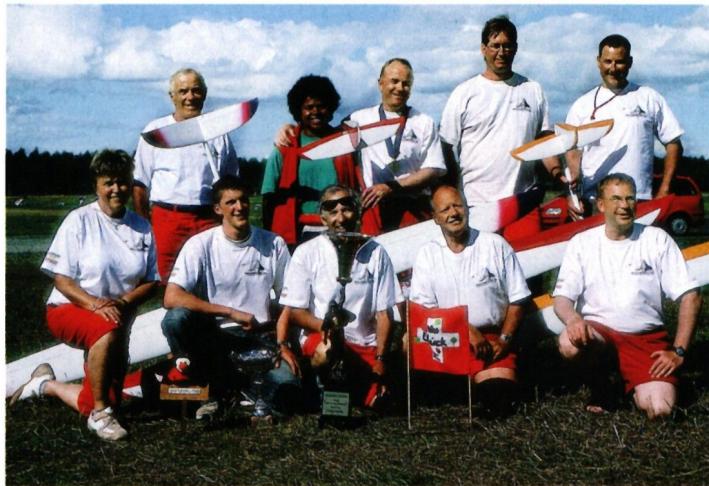
It was clear from the start that Andreas Böhlen—known as “Res”—would focus on defending his title and therefore would not compete in the team competition. As a result, the three pilots—Paul Böhlen, Christian Hanke, and Roland Hofmann—formed the Swiss team for the team competition. Incidentally, Paul Böhlen—Res’s father—was already confirmed at that time, at 64 years old, as one of the oldest participants in this year’s World Championship, alongside the Italian Franco Givone. So flying seems to keep you young, and as it turned out, the two of them were still able to show the much younger competitors a thing or two. As readers can surely imagine, a World Championship like this requires careful planning. Team Switzerland and Team Liechtenstein, with pilot Fidel Frick, decided to prepare for the World Championship together. The following volunteers were recruited to support the Swiss team: Käthi Böhlen, Christoph Helbling, Walter Reist, Rudi Schaub, Thomas Schorb, Markus Wanner, and Angela Waldvogel. A heartfelt thank you for your tireless efforts. In the run-up to the World Championships, the team met for a total of three weekends to train together. In addition to the team training sessions, the group attended the Eurotour competitions in Salzburg, Italy, and Sélestat (including the Speed Cup) together, putting the World Championship support team through its paces under real competition pressure. This was supplemented by individual training by the pilots, in some cases up to four times a week. The preparations were significantly hampered by a skiing accident involving Christian Hanke as well as several model malfunctions resulting from excessive motivation and a willingness to take risks during training.
The entire team arrived in Lappeenranta on Thursday, before the competition began, to make the final adjustments on site. An old military airfield, located about 50 km from Lappeenranta, served as the training site and was used extensively by many teams at various locations across the sprawling grounds. On Saturday, the team was able to train at the World Championship venue for the first time.
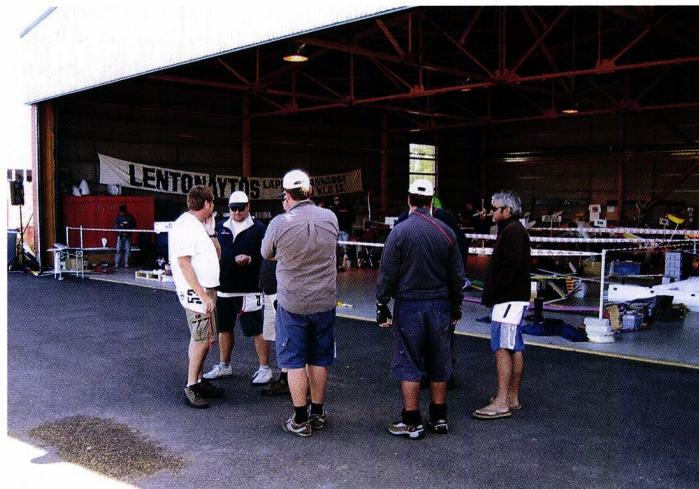
A huge hangar was made available to the teams for their equipment. The organizer also set up a Wi-Fi network that provided perfect access to the latest competition results as they were updated. In the afternoon, the zero round kicked off with the cross-country flight discipline. Everything ran smoothly on the organizers’ end, which was certainly also thanks to the top-notch F3B facility. This facility had been specially “flown in” from Munich/Kassel along with all the key helpers. This top-notch organization remained consistent throughout the competition, and the official volunteers deserve great praise for their hard work. Other foreign volunteers were also on hand with the (other?) F3B teams. Jens Buchert from the Logo Team took over team management for the Australians and was supported by reigning F3J World Champion David Hobby. Our “adopted Spaniard,” Walter Reist, supported the Spanish team.
Monday, Day 1: After the usual official welcome ceremonies—which also included a presentation of the various team outfits, which were particularly diverse and unconventional this year—the first round of timed flying began. As had already been observed during on-site training, the thermals in Finland are brutally tight and leave no room for error. Tight, clean, and consistent circling was the order of the day. Joe Wurts, the ultimate thermal expert, learned this the hard way later in the competition when he made an out-of-bounds landing about 800 m from the landing point. Locally confined thermal lifts at the edge of the forest could even be clearly recognized by the swaying trees—a phenomenon rarely observed in Central Europe. In the speed and distance disciplines, conditions were very consistent, so there were no major outliers. The first day presented no major problems for Team Swiss; everyone was in good spirits and therefore celebrated Swiss National Day (the anniversary of Switzerland’s founding) in style that evening.
Pasi Väisanen, a native of Finland with a Swedish passport, was very familiar with the thermal conditions; as a result, he deservedly took the lead in Round 1 with 3,000 points. And this despite the fact that, by his own account, he had been able to make only four test flights in the run-up to the World Championship to test his models because he was building a house.
Tuesday, the second day: The round of the second heat that had begun the previous day was completed. Everyone was eager to see the speed results. Fidel Frick (LIE) managed to complete the 1,000-point round in just 17.02 seconds despite fairly sluggish air, but he couldn’t prevent Andreas Herrig from winning Round 2. The third round began with a focus on speed. Times under 18 seconds were only achievable by taking the highest risks and executing extremely tight turns. Res completed the 1,000-meter run in 17.19 seconds and ultimately won Round 3. In the subsequent cross-country flight, several brilliant duels were observed, as were, unfortunately, a few collisions with rapidly growing Finnish trees. Attempts to stay in good air as long as possible were mercilessly penalized and, in some cases, even “rewarded” with 100 penalty points for landing in the safety zone.
Wednesday, the third day: A strong wind blew in the faces of all the volunteers as they set up the winches at the launch sites, which were reassigned each day. For the first time, ropes with a diameter of 1.35 mm were installed on the Swiss winches. The organizer’s schedule for that morning was to complete the distance discipline and then begin the fourth round with endurance flight. This competition day then concluded at 4:00 p.m.—earlier than the usual 7:30 p.m.—to give the teams a breather and allow the team managers to enjoy an outing and experience a genuine Finnish wood-fired sauna. Initial projections were made. Res was a few points ahead after winning Round 4, but so far no one had really been able to pull away from the pack. The battle for the team title was already fierce. The “untrained” Swedes were right up there with the Americans, the Germans, and the Swiss from the very start. There were even rumors that the Swedes had deliberately spread this rumor about being “untrained” as a tactical move. The Japanese also flew very consistently and at a high level—so things remain exciting at this World Championship.
Thursday, the fourth day: The worst day for us in terms of thermal flying and cross-country flying. Everyone except Res—who also won this fifth round—lost valuable points in the team standings. The German team, on the other hand, was able to steadily extend its lead over second place with very clean and consistent flights. This sparked a fierce battle for second and third place in the team standings between the Americans and the Swedes. After the Americans, too, had to make two unpleasant encounters with the Finnish treetops during cross-country flights—resulting in poor distance flights being counted toward their score—second place was now all but secured for the Swedes. The team competition now shifted to the battle for third place between the Americans and us Swiss.
The sixth round began that same day. Endurance flying was on the agenda—and what a challenge it was! Visibility conditions that evening caused difficulties for many pilots, and some flew almost blindly. Among the Swiss pilots, too, there were an unusually high number of stick commands, relayed verbally from the helper through the pilot to the model. A few particularly unlucky pilots didn’t even make it back to the airfield, which in Finland meant a trek through dense forest undergrowth. Fortunately, however, the organizer provided a GPS device, which was intended to significantly simplify a systematic search in the undergrowth. Judging by the size of the models, some pilots were still searching for thermals at distances of over 1 km—and at altitudes that no longer guaranteed a safe return. In F3B, especially at a World Championship, giving up is unfortunately not rewarded.
As an absolute treat, the competition director then launched the speed round of the sixth round. Res still held a slight lead over the runner-up. The two Andreas (Res and Andreas Herrig) were locked in a fierce neck-and-neck race. In the end, everything was up for grabs again, as Andreas Herrig won the speed run with a time of 15.83 seconds to Res’s 16.20 seconds. After part of the endurance flight for the sixth round, the competition for the day came to a close. So the suspense continued; tomorrow would bring more endurance flying, followed by cross-country flying. Andreas Herrig was able to take the day in stride, since—unlike Res—he hadn’t made any mistakes in either the distance or endurance flights and could therefore afford to have two discards. However, if Res were to complete both the endurance and distance flights, he would become world champion by a narrow margin.
Friday, the fifth day: The Finnish skies opened up, and by noon, continuing the F3B competition was out of the question. A few die-hards organized a paper airplane distance flight competition in the hangar. The pilot who flew the longest distance would win. It was a fun little event.
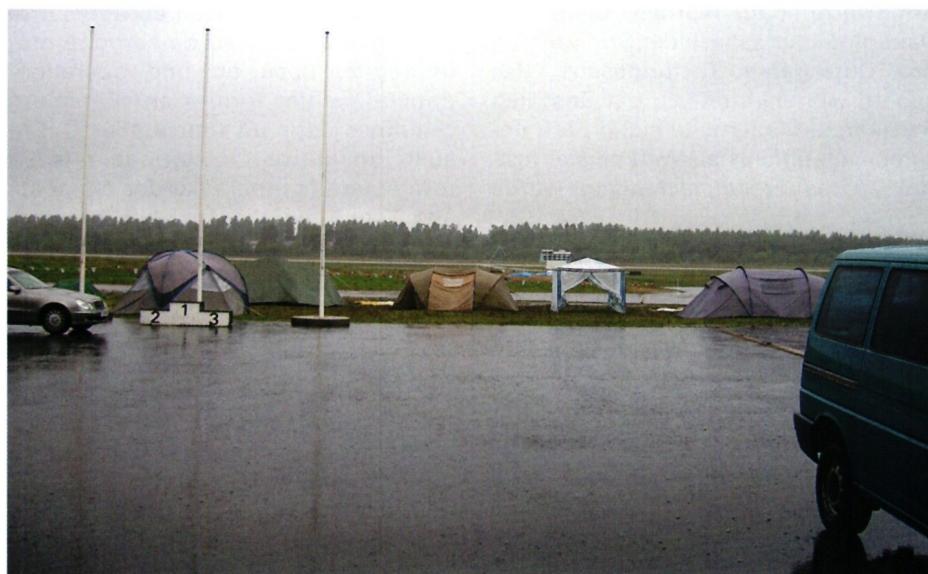
In the afternoon, the endurance flight and then the cross-country flight of Round 6 continued. As expected, Res achieved the desired results and, as far as we understood, was confirmed as world champion. Late Friday afternoon, a seventh round was announced—unexpectedly for many. This meant the race for first and third place in the individual standings and for third place in the team standings was wide open again. Morale had hit rock bottom for many teams. Five days of competition take a toll on both strength and nerves.
Saturday, the final day: This last round became extremely exciting once again because the leaders in the endurance and distance flights didn’t lose any significant points. The decision—both in the individual standings and for third place in the team standings—would therefore have to be decided in the very last speed flight.
Christian Hanke kicked off the speed flight event and set a breathtaking time of 15.63 seconds, a mark that could not be beaten for the rest of the competition. Unfortunately, his Swiss teammates were unable to match this energetic performance and thus lost the team competition for third place to the U.S. by a margin of just under 58 points. If we’d been just 1 second faster in the speed flight, we would have stood on the podium. We’re working on it... Res and Andreas Herrig, in first and second place in the individual standings, were separated by just 52 points after taking into account the endurance and distance flights from Round 7, as well as the discard scores. Their worst speed flights were equally “poor,” each scoring 874 points. Herrig had to go first and achieved the nearly impossible. With incredibly tight turns in otherwise still air, he flew the speed leg in 16.12 seconds, improving his worst speed flight score to 969 points and putting him 43 points ahead of Res. Res now had to score a total of 917 points (=874+43) in the final speed run—or achieve a speed time faster than 17.18 seconds. On the first high launch, the model simply wouldn’t build up enough lift, though the altitude didn’t look bad. He decided to attempt a relaunch anyway due to the “poor” air conditions. The conditions improved; the wind was almost blown away given the line pull, and he took off. And how he flew! While Herrig had given the impression that it couldn’t get any shorter, Res proved us wrong and once again demonstrated his class with a time of 16.15 seconds. With a lead of about 51 points, he was crowned world champion once again.
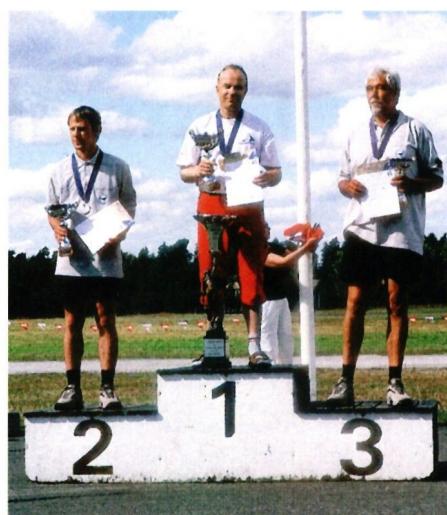
| 1 | Andreas Böhlen | SUI | 17,775.33 |
| 2 | Andreas Herrig | GER | 17,745.97 |
| 3 | Reinhard Liese | GER | 17,521.57 |
| 4 | Martin Weberschock | GER | 17,502.72 |
| 5 | Pasi Väisänen | SWE | 17,463.66 |
| 6 | Joakim Ståhl | SWE | 17,347.54 |
| 7 | Wurts, Joe | USA | 17,252.82 |
| 8 | Smith, Mike | USA | 17,130.49 |
| 9 | Hofmann, Roland | SUI | 17,107.93 |
| 10 | Peter Hoffmann | AUT | 17,051.39 |
| See also: | |||
| 12 | Christian Hanke | SUI | 16,954.27 |
| 13 | Fidel Frick | LIE | 16,815.54 |
| 15 | Böhlen Paul | SUI | 16,749.31 |
| 1 | Germany |
| 2 | Sweden |
| 3 | USA |
| 4 | Switzerland |
| 5 | Austria |
| 6 | Denmark |
| 7 | Czech Republic |
| 8 | Belgium |
| 9 | Australia |
| 10 | France |
The English team surprised everyone with a very lightweight prototype of a homemade prepreg aircraft. The pre-impregnated carbon fiber fabric is cured in a single step in an oven at around 150 °C inside aluminum wing molds. The carbon fiber fabric is held in place using silicone bags that fill all the cavities of the wing. Unfortunately, the model crashed due to a servo gear failure. What a shame. The Swedes, on the other hand, relied on their tried-and-true race machine, which has been in continuous use at world championships since 1999 and was also flown by the young Finnish team. However, word is that the speed and endurance performance are set to be improved. We can certainly look forward to seeing the results.
Generally speaking, there’s a noticeable trend toward faster airfoils. Pilots are trying to manage the endurance flight challenge by keeping the wing loading low. In this regard, Andreas Herrig’s “Schocker”—which is small by F3B standards—stood out very positively. It was unbeatable, especially in distance flights, winning 5 of its 7 distance flights by a margin of at least 2 courses. The model maintains its speed consistently and was flown to perfection by Andreas. Like the “Schocker,” the “Crossfire” model from aerotec—flown by new world champion Andreas Böhlen and Christian Hanke—is also designed for a fast basic configuration. The model impresses with fast speed flights at moderate ballast levels combined with powerful high-altitude launches. A dangerous combination. And it also seems to be easy to fly. Christian Hanke decided on this model at the last minute in Finland, even though he had prepared for the World Championships with his “Wobbegong” from the Logo Team. Liese relied on the new “Estrella,” while the US team stuck with the old “Estrella.” Martin Weberschock opted for the “Europhia II,” and Hofmann and Bachler (Austria) tried their luck with an upgraded version of the “Phönix.”
In addition, the “Supersonic EX,” “Espada,” “Caracho 3000,” “Furio,” and “Victor,” as well as other commercially available models, were also in use.
As has been the case in previous years, speed is the deciding factor in the competition. The other two disciplines are more or less mandatory and simply have to be flown to the fullest. So here are a few quick words about speed turns. Herrig prefers extremely gentle speed turns with a turn radius of about 15 meters, whereas Reinhard Liese favors sharp, extremely tight turns. According to Herrig, his glider would “stall” during tighter turns. Logically, this means his model must be significantly faster on the course to keep pace with his competitors. It was not possible to conclusively determine which approach is the better solution. Res does not fly as extremely as Reinhard and falls somewhere between the two flying styles. Unfortunately, it is not possible to make a statistical statement because only Herrig practiced this flying style at the World Championships. No groundbreaking new developments were observed in terms of winches or lines. According to EMC-Vega, the Speedline lines were slightly increased in diameter and given even more stretch to allow for greater launch altitudes in windy conditions. Lines from other manufacturers were, of course, also in use. With lines, it’s probably the same as with batteries and airfoils. Faith moves mountains. The System Hollenbeck winches are now being replicated by the Swiss modeler Walter Reist and can be purchased from him at a reasonable price. The Swiss and the Spanish used these winches to their complete satisfaction.
As in previous years, Graupner dominated the remote control technology used. The Swedes and the US team continue to rely on MPX. Other brands were also spotted here and there.
Heartfelt congratulations to the world champion and the entire F3B team, and many thanks to our sponsors. We extend our sincere thanks to our sponsors EMC-Vega, Graupner, Optik Steinle from Thun, and RC-Solutions.ch. For more information, see: www.f3b.fi, www.teamswiss-f3b.ch
(Interview: Christoph Helbling)
How did you personally prepare for the World Championships in Finland?
– My preparation actually began right after the World Championships in Kirchheim. I tried out just about every model available on the market until, quite by chance, I stumbled upon the right one three months before the World Championships. After that, of course, it was a matter of putting together a team and planning our preparation for the World Championships.
That all sounds very time-consuming?
– It is, and it definitely shouldn’t be underestimated. Because thorough and proper preparation can save you a lot of trouble.
What were your feelings as you traveled to Finland?
– I went to Finland with mixed feelings. On the one hand, I was excited to experience something new and to fly in a different location. On the other hand, I also felt a bit uneasy, because it’s not that easy to enter the competition as the defending champion.
And how did this World Championship ultimately go for you?
– On Friday, we suddenly heard there would be a seventh round, and that threw me off. Since I’d already been crowned world champion after the sixth round, I initially struggled to get motivated again. But when it became clear on Saturday that I’d won the title again, I was overjoyed. I’ve achieved more than I ever dared to dream.
And how do you feel today? After this World Championship? And as a two-time consecutive world champion?
– For me, even the first title was the crowning achievement and the highlight of my F3B career. Defending the world championship title was a lot harder, and therefore more significant than winning it for the first time. I also see this second title as confirmation of my achievements, and I’m glad it worked out a second time.
Finally: What does the future hold for you? Any plans?
– For me, the focus is now on career changes. I’ll continue to fly F3B, since it’s my great passion, but not as intensively as I did before a world championship. I’ve also fulfilled a big dream and bought a large sailplane.

EURO CONTEST GLIDER ACRO TOUR AUSTRIA 2026

THE PC-21 STORY
 Emil Giezendanner

TWIN TOWN PARTNERSHIP
 Wolfgang Voeller

SUMMER FUN 2026 AT MG USTER
Martin Wunderli
CORSAIR F4U – A WARBIRD WITH A MEMORABLE LOOK
Jürgen Rosenberger, Jürgen Prinz
52. 2026 ALPS CUP
Emil Giezendanner
YOU KNOW WHAT I MEAN? 125 YEARS OF THE SWISS AERO CLUB
Emil Giezendanner
News from HEBU

TEAM MANAGER "THIS" BOSSHARD
Rodito Nussbaumer
ATOM, THE NEW DOUBLE-DECKER FROM CPLR
 Matthias Bosshard

F3A EUROPEAN CHAMPIONSHIPS IN ST-MACAIRE, FRANCE
Matthias Bosshard
INSIGHTS INTO THE HISTORY OF SEAPLANES

WELCOME, NEW MEMBER!
Andrea Bolliger
What's New at Leomotion.com

PRIDE AND GOOD IDEAS
 Markus Nussbaumer

SMALL, MODEL-LIKE SAILBOATS
Res Dauwalder
FREE FLIGHT IN THE MIDDLE OF SUMMER
Urs Muntwyler
BY YOUTH, FOR YOUTH
Lorena Betschen
34th HAHNENMOOS ALPINE MODEL AIRPLANE CAMP
Res Dauwalder
HORIZON HOBBY/LEMACO NEWS: MICRO OV-10 BRONCO 645 MM BY E-FLITE

COUPE DES ALPES – OBSERVE AND LEARN
Rodito Nussbaumer
TRY-OUT DAY AT MFV WETTINGEN
 Urs Keller

NEWS FROM HEBU
 Julia Bucher

NOS REGION – A HUB FOR ELECTRIC AVIATION
Emil Giezendanner
MEMORIES
 Wolfgang Völler

70 YEARS OF THE NIDWALDEN MODEL AIRPLANE CLUB
Martin Barmettler
A SPECTACULAR F3A WORLD CUP IN THE PRINCIPALITY OF LIECHTENSTEIN
Emil Giezendanner
FROM 0 TO 100
Markus Nussbaumer