
People from French-speaking Switzerland are building at CLAM: a small glider just for fun
François Bommottet is a charismatic figure at CLAM (Club Lémanique d'Aéromodélisme). When he proposed building a model of his own design, milled on a CNC machine, a dozen enthusiastic modelers answered the call. They set out on an adventure spanning eight 3-hour sessions, culminating in a small 1.35-meter glider built purely for fun.
The prototype of this model was designed as a vacation glider that takes up little space in luggage and can fly on uneven slopes without much trouble. For maximum flying enjoyment, it is equipped with ailerons that make it highly maneuverable and suitable for aerobatics. It features a “V”-shaped tailplane
for greater ease of construction combined with proven durability, particularly in tall grass.
Having acquired a CNC milling machine as part of his professional work, François now had to create the programs for cutting the various components of his glider. Unfortunately, the belief that computer-controlled milling effortlessly produces perfect gliders is a pipe dream. François does not own a vacuum table to hold the wood strips in place during cutting. For professional use, such a table would cost almost as much as the CNC machine itself. So he used double-sided tape to secure the
to his milling table. Removing the milled parts took hours of work. Furthermore, the balsa parts come out with numerous burrs that are unsightly for a transparent glider. Finally, materials such as fiberglass are highly abrasive. A conventional milling cutter lasts about 15 meters in this type of material before it ends up in the trash. This gives a better understanding of the work involved in preparing a dozen gliders for a model-building class.
When you take a closer look at the construction of this small model, you’ll notice many unusual design choices. The carbon tube spar
extends to the wing tip via a rectangular fiberglass sandwich spar with a balsa core. The leading edge is a carbon rod bent using heat (a lighter). The leading edge of the aileron is a carbon tube with a pivot pin inserted into it. This aileron pivots between two 0.6 mm fiberglass flanges. The aileron, with its miniature fiberglass ribs, is removable. The trailing edge is cut from a 0.6 mm fiberglass sheet. The rib that supports the servo consists of a balsa core sandwiched between two fiberglass sheets. The “V”-shaped tail is constructed similarly to the wing, with 0.6 mm fiberglass ribs. It is, in a sense, made entirely of plastic. 2 mm carbon rod struts are
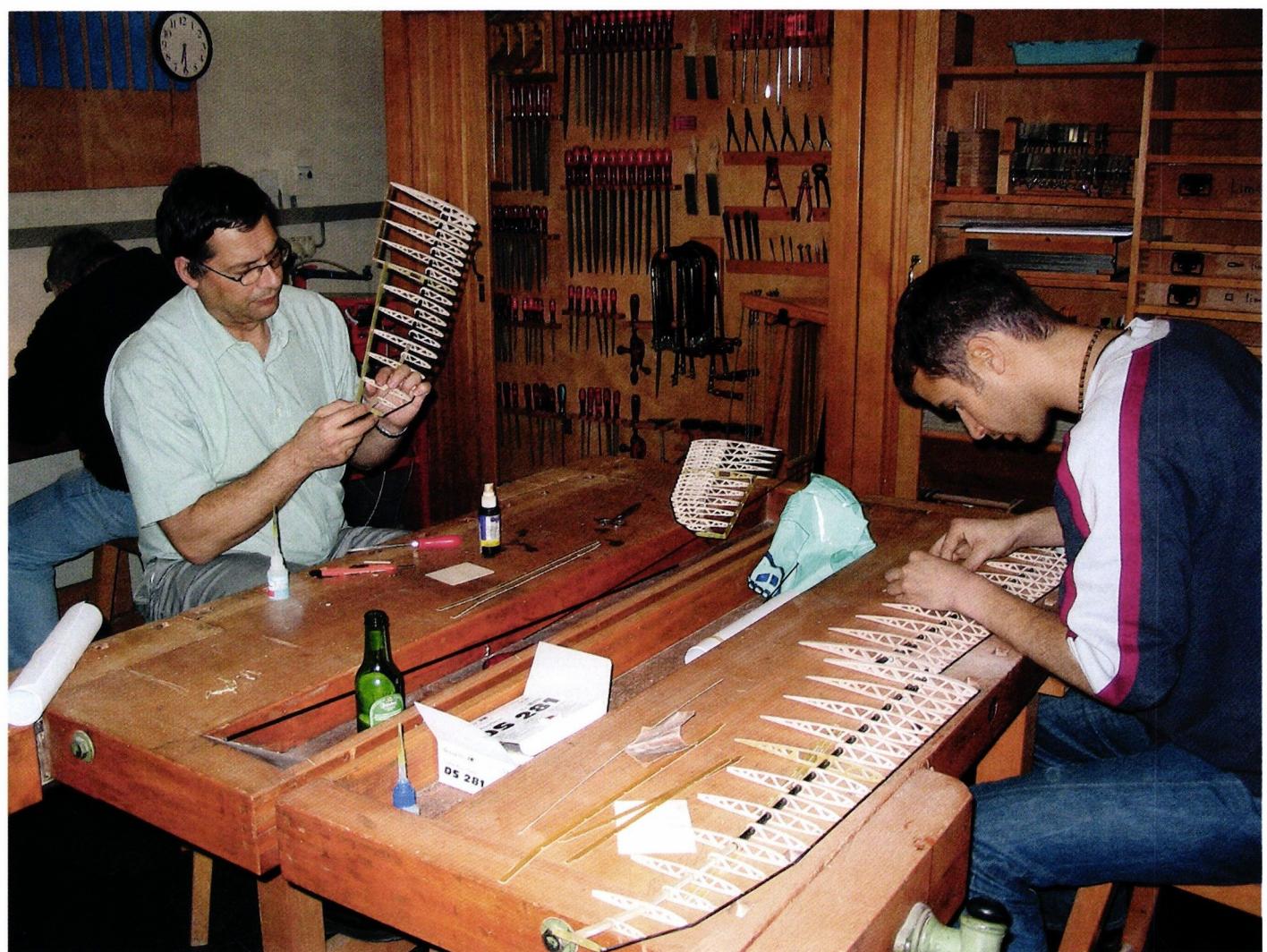
attached to the fuselage and run directly into the tail section through the ribs without passing through the usual tubes. The front of the fuselage is milled from a block of balsa wood. It consists of two shells that house the servos, the NiMH battery, the switch, the charging port, and the receiver. These two shells snap together, securing the radio control components in place. These components are therefore neither glued nor screwed in place. A fiberglass plate is located between these two shells, providing reinforcement in the event of a head-on impact. This plate reinforces the wing joint. A winch hook is integrated into it. The fuselage achieves its full torsional rigidity when the two half-shells are assembled using simple adhesive tape. The rear spar is a carbon tube. All glued parts of the model are bonded with instant adhesive to save weight and time.
A model with openwork ribs is a delight to the eye. A transparent covering is therefore essential. It also allows you to inspect the wing for any damage. Much of the wing’s rigidity comes from the fabric covering. Some gliders are built with only one elevator servo, at the expense of the rudder. The tail is then controlled by a piano wire soldered in a “Y” configuration. The fuselage is also covered with fabric. For a glider like this, it is recommended to stretch the fabric using a high-powered hair dryer. Be careful not to deform the structure! The finished model, equipped with 4 miniature servos, weighs approximately 350 grams. The two wings are connected by a carbon spar. The wings and tail are secured to the fuselage with simple adhesive tape.
The first tests were conducted right in the schoolyard where the model-building class was held.
A bungee cord made from a string of office rubber bands (!) was used to launch the model... just to make sure this glider was truly built for fun. Launching it with a real bungee cord poses no problem; the model is sturdy and has little to no risk of breaking in flight. The ailerons make it very maneuverable. But it’s when flying off a slope that this glider is the most fun. It can maneuver in a tiny space, catch the slightest breeze, and handle surprising variations in speed. A few extra grams of lead make the flight paths even tighter. Simple maneuvers on its back or belly are no problem at all, though it shouldn’t be considered an acrobatic machine: “just for fun.” Its RG15 airfoil makes it a true all-rounder. To get the most out of it, servos with no play are highly recommended. Landing with the ailerons raised is a breeze with such a lightweight glider.
Here is a versatile, all-around glider that’s a pleasure to fly thanks to its transparent elliptical wing. You could easily make improvements to it, though at the expense of build time: removable servos without having to remove the fabric from part of the wing, and a lighter wingtip spar. In my opinion, the hollow ribs are more for looks than practicality. They make the model fragile during assembly. But its flight characteristics have surprised more than a few people. This building workshop was a chance to have a great time with a group of friends: we learned a lot, drank a lot, and laughed a lot—we had a blast. Another big thank you to the organizer.
Thierry Ruef

EURO CONTEST GLIDER ACRO TOUR AUSTRIA 2026

THE PC-21 STORY
 Emil Giezendanner

TWIN TOWN PARTNERSHIP
 Wolfgang Voeller

SUMMER FUN 2026 AT MG USTER
Martin Wunderli
CORSAIR F4U – A WARBIRD WITH A MEMORABLE LOOK
Jürgen Rosenberger, Jürgen Prinz
52. 2026 ALPS CUP
Emil Giezendanner
YOU KNOW WHAT I MEAN? 125 YEARS OF THE SWISS AERO CLUB
Emil Giezendanner
News from HEBU

TEAM MANAGER "THIS" BOSSHARD
Rodito Nussbaumer
ATOM, THE NEW DOUBLE-DECKER FROM CPLR
 Matthias Bosshard

F3A EUROPEAN CHAMPIONSHIPS IN ST-MACAIRE, FRANCE
Matthias Bosshard
INSIGHTS INTO THE HISTORY OF SEAPLANES

WELCOME, NEW MEMBER!
Andrea Bolliger
What's New at Leomotion.com

PRIDE AND GOOD IDEAS
 Markus Nussbaumer

SMALL, MODEL-LIKE SAILBOATS
Res Dauwalder
FREE FLIGHT IN THE MIDDLE OF SUMMER
Urs Muntwyler
BY YOUTH, FOR YOUTH
Lorena Betschen
HORIZON HOBBY/LEMACO NEWS: MICRO OV-10 BRONCO 645 MM BY E-FLITE

34th HAHNENMOOS ALPINE MODEL AIRPLANE CAMP
Res Dauwalder
COUPE DES ALPES – OBSERVE AND LEARN
Rodito Nussbaumer
TRY-OUT DAY AT MFV WETTINGEN
 Urs Keller

NEWS FROM HEBU
 Julia Bucher

NOS REGION – A HUB FOR ELECTRIC AVIATION
Emil Giezendanner
MEMORIES
 Wolfgang Völler

70 YEARS OF THE NIDWALDEN MODEL AIRPLANE CLUB
Martin Barmettler
A SPECTACULAR F3A WORLD CUP IN THE PRINCIPALITY OF LIECHTENSTEIN
Emil Giezendanner
FROM 0 TO 100
Markus Nussbaumer