
Airship ahoy!
It was like a Christmas present: On December 24, 2002, we were able to pick up a large crate weighing 150 kilograms at the Zurich airport. Surprised by the weight and size of the crate, I realized right away that we could only pick it up with the Zeppelin trailer.
So we drove there and—after the usual paperwork—had the crate loaded onto the trailer. However, the crate remained sealed for a few more days. We wanted to open it only in the presence of the manufacturer in charge, who traveled to Zurich to oversee the assembly and acceptance of the Zeppelin. On January 3, 2003, the time had come: Nigel Wells from “Airspeed Airships” had arrived from England. He had designed the magnificent AS-800 airship. We opened the crate and began assembling the airship. Our custom-built trailer, measuring 12 meters long, 2.55 meters wide, and 3.60 meters high, served as a hangar. To this day, it remains the hangar for the airship—which is always ready to fly—and can accommodate it in its full size.
First, we had to start the engines. To do this, we positioned the nacelle at the edge of the trailer. But what did we discover? The engines weren’t running smoothly! They kept stuttering slightly. Flying in this condition would have been out of the question. So we began inspecting the tanks and hoses, since our initial assumption was that the engines weren’t getting enough fuel. After two hours of fruitless trial and error, we finally tried using a different type of fuel. Even though we used exactly the required mixture of methanol, nitromethane, and synthetic oil, the problem could still have been with the fuel. And sure enough: it worked! The engines ran smoothly, without any stuttering—just as they were supposed to!
So we quickly set about filling the envelope with helium. Still, it had gotten too late to launch that same day. By evening, we had the airship ready to fly, so we were looking forward to the next morning, when we would fly it for the first time. However, we weren’t spared a little surprise: the airship, ordered at 10.0 meters, should theoretically have fit inside the trailer’s 10.1-meter-long interior. But now it was sticking out half a meter from the back of the trailer. What had happened? The airship had been built slightly longer than planned. That wasn’t really such a big deal, because we could remove the rear control propeller and push the envelope in a bit so that the trailer could still be closed. But of course, it wasn’t a clean solution. So we later decided to attach a one-meter extension to the front of the trailer. Now the airship fits inside completely. But back to the first day of flying: We drove to the First model airfield, which belongs to the Illnau-Effretikon Model Flying Club. Unfortunately, it was pouring rain. This wasn’t going to change over the next few days while Nigel was still staying with us. But the airship is waterproof, after all, and immediately passed its first endurance test. Under Nigel’s guidance, we got the airship ready. We didn’t have any experience with something like this ourselves. Finally, we started the engines, and the airship took off for the first time. Nigel was at the controls, and we were all thrilled by how elegantly the airship made its first laps. Our excitement took our minds off our cold fingers and toes, which are just part of model flying in early January. Between flights, we were able to warm up in the cozy clubhouse. The rain really didn’t bother the airship at all, even when we filled the gondola with rocks to test its maximum payload. Admittedly, rocks weren’t the ideal cargo, but it worked anyway. We were able to lift 9 kg of stones into the air. Nigel said he’d never flown at that limit before, and he was clearly uncomfortable with it. For us, however, it was important to determine whether the required payload could actually be lifted into the air. If you add 2 kg of rainwater on the canopy to the 9 kg of stones, plus two or three additional stones that could easily have been loaded, we reached the agreed-upon 12 kilograms of payload. This was a very important acceptance criterion for us. After all, we planned to carry technical equipment such as a TV camera, a projector for video presentations, etc., into the air later on, which is why we depend on this payload capacity. So the first day of flying went off without a hitch. And the flights on the second day also went very smoothly. We focused primarily on pilot training and familiarizing ourselves with the controls so that we wouldn’t have any problems once Nigel was gone. However—we weren’t entirely spared from problems...
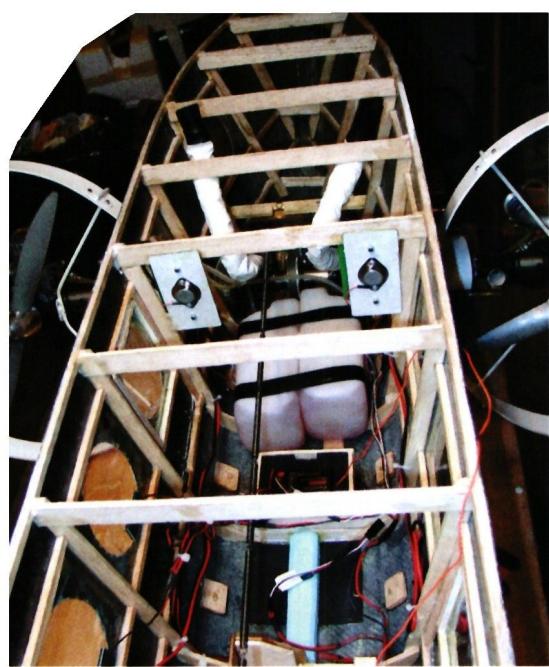
The airship is equipped with two OS BX-1 hot-glow engines, each with a displacement of 18 cm³. With a total length of 10.5 meters and a diameter of 2.6 meters, the Zeppelin reaches a maximum speed of about 46 kilometers per hour. The propellers, surrounded by a protective ring, can be swiveled upward so that the thrust is directed downward. In English, this is called “vector thrust.” Downward thrust is particularly useful during hover, when forward speed is not desired. Each engine is fed by a separate 1-liter tank, giving the airship a flight duration of 40 to 45 minutes. Flight time depends primarily on the motor speed. Hovering requires a higher speed, so more fuel is consumed than during straight-line flight. Frequent hovering therefore results in a shorter flight time. Power was originally supplied by two 4-cell batteries with 2000 mAh. One battery powered the receiver and controls, the other the thrust control. After all, there’s a 20-kg servo installed there that draws a lot of power. That’s why it’s powered separately. However, we’ve since greatly improved the power supply by now using two 5-cell batteries with 3000 mAh for the receiver via a battery switch. For the thrust control, we connect two 4-cell batteries in parallel. This now provides sufficient safety. In fact, we later had a minor incident during a test flight where we almost lost control of the airship because the battery voltage was running low. In the end, we still managed a safe landing, but it was a close call! The reasons were likely the freezing cold, which took a toll on the batteries. Additionally, the control surfaces were a bit stiff, resulting in higher power consumption by the servos. We’ve since corrected all of these issues. Furthermore, the batteries were likely not charged optimally, which is something we have to take responsibility for... The airship was originally controlled using a Futaba 6-channel PCM remote control. However, we have since replaced it with an 8-channel controller. We need the two additional channels to control the sensitivity of the recently installed gyros (electronic stabilizers) from the ground. The airship’s envelope is made of a coated nylon fabric and can be heat-sealed. This property is particularly useful for repairs and “add-ons.” The gondola is made of a carbon-fiber-Kevlar structure, reinforced by a balsa wood frame.
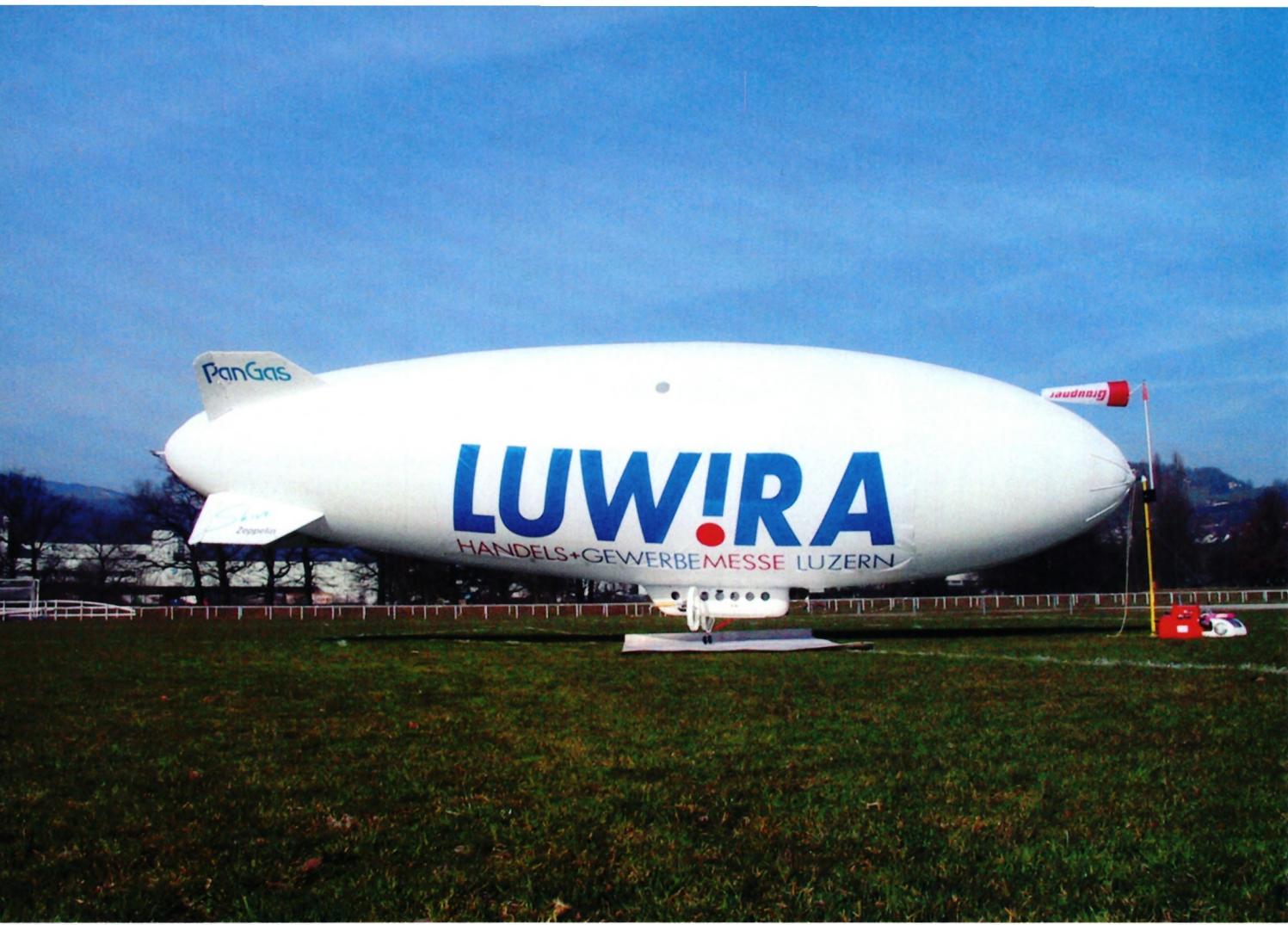
You always learn the hard way at first. It was no different for us. Nigel Wells had left by then, so a week later we decided to attempt our first flight on our own. Since the airship was still equipped with floats at the time, we thought we could take off from the ground like an airplane instead of launching it by hand from a safe height. So we positioned the airship on the hard-packed snow and opened the throttle. It actually worked—or so it seemed at first. But as we began to climb, the two lower control surfaces touched the ground and snapped off. We had a major problem! Only the two upper rudders were left. The turn we now had to make inevitably resulted in a massive loss of altitude. That’s why we couldn’t make a turn and kept flying farther and farther away. We could no longer control the airship. Our only goal was to fly over the nearby high-voltage power line at any cost! We managed to do that, but the airship disappeared behind the forest… We were still reeling from the shock. Was the airship lost? Was it impaled on a tree? We began searching and soon spotted a limp envelope in some trees that weren’t too tall. So now it was time to recover it—and to do so in a way that caused as little additional damage as possible. We spent a full three hours carefully maneuvering the airship out of the trees. Finally, we saw that it wasn’t damaged all that badly. The gondola, engines, and propellers still looked intact. Only the envelope had sustained a 4-meter-long tear. We then spent a month getting the airship back “up and running.” After removing piles of “forest souvenirs”—such as branches, pine needles, and other debris—from the envelope, we were able to repair it thoroughly. We also quickly glued back together a few broken ballast struts in the gondola. But we took this opportunity to make some technical improvements as well: most notably, a mechanical reinforcement of the thrust control and precise lead trim weights instead of stones.
The subsequent test flights were consistently successful, as we learned more with each one and were already able to handle and fly the airship quite well. We then took our first aerial footage using a video camera on loan from SF DRS, and by March 2003 we were already able to carry out our first advertising assignment in Lucerne. There were minor incidents time and again. For example, the power shortage mentioned above. Or the fact that the original wooden propellers came loose when the engine started, which each time led to a lengthy screw-tightening session. In particular, the spinners (propeller cowls) were attached to the rim with two screws, so the propellers had to be aligned very precisely, which made it practically impossible to tighten them properly. We’ve since changed all of that: APC plastic propellers and spinners bolted in the center solved the problem. But the weather also gave us a run for our money—not because of the heat, but because of the wind! When we were filming the Schaulager complex in Basel, there were turbulent westerly winds. Normally, a westerly wind is a good, steady wind, but amid the large buildings where our launch site was located, the turbulence was so severe that landing became a real feat. In the end, however, we made it down unscathed thanks to our pilot’s skill. We also had a thrilling landing during a test flight: the airship hit a downdraft about five meters above the ground and plummeted downward like a stone. It was only thanks to an uncompromising dive-like maneuver that we managed to catch the airship. Aside from a damaged propeller and a hole in a T-shirt, there was no damage. But in the meantime, these adrenaline rushes have become rare, since we’ve gained quite a bit of experience and developed a routine. We’ve now completed dozens of trouble-free takeoffs and landings, and the numerous improvements and refinements are paying off: safe and relaxed flying—and a whole lot of fun!
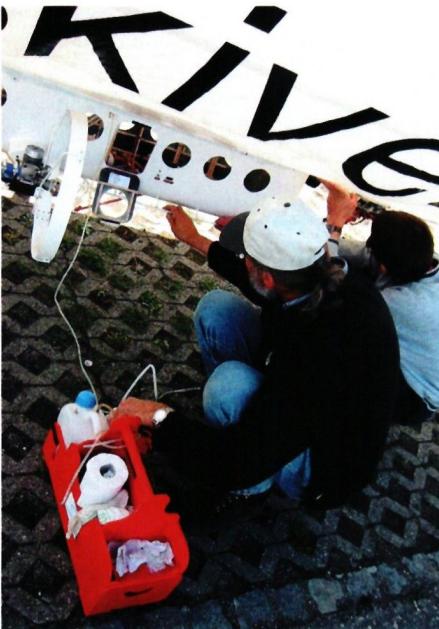
It’s always exciting to see what the future holds. This summer, we’d like to offer zeppelin advertising to various clients. We’ve already successfully completed a few projects. Advertising is a key pillar of SKIVE Aviation AG, as the large zeppelin envelope and its excellent flight characteristics provide an ideal advertising platform. The company’s other pillar is aerial photography. We are already able to produce professional aerial video footage, as we did, for example, at the Schaulager in Basel. Our vision is to soon broadcast live aerial footage for Swiss television using sophisticated technology and aviation expertise. We’re well on our way, but professional broadcast transmission places very high demands that must be met.
We’re still in the process of rounding out our team of pilots. If you’re an experienced model aircraft pilot interested in learning to fly a Zeppelin, we’d love to meet you. A certain degree of flexibility is required, as this part-time position involves flights sometimes during the week and sometimes on weekends. To ensure this flexibility, we’re aiming to build a team of about five pilots. Please give me a call at 079 236 61 59. Thank you very much!
Our website provides further information about the Zeppelin, the company SKIVE, and where you can see the Zeppelin in flight next: www.skive.ch.
Contact:
SKIVE Aviation AG
Scheuchzerstrasse 163
CH-8057 Zurich
Tel. 01 350 75 00
Fax 01 350 75 01
contact@skive.ch
www.skive.ch

EURO CONTEST GLIDER ACRO TOUR AUSTRIA 2026

THE PC-21 STORY
 Emil Giezendanner

TWIN TOWN PARTNERSHIP
 Wolfgang Voeller

SUMMER FUN 2026 AT MG USTER
Martin Wunderli
CORSAIR F4U – A WARBIRD WITH A MEMORABLE LOOK
Jürgen Rosenberger, Jürgen Prinz
52. 2026 ALPS CUP
Emil Giezendanner
YOU KNOW WHAT I MEAN? 125 YEARS OF THE SWISS AERO CLUB
Emil Giezendanner
News from HEBU

TEAM MANAGER "THIS" BOSSHARD
Rodito Nussbaumer
ATOM, THE NEW DOUBLE-DECKER FROM CPLR
 Matthias Bosshard

F3A EUROPEAN CHAMPIONSHIPS IN ST-MACAIRE, FRANCE
Matthias Bosshard
INSIGHTS INTO THE HISTORY OF SEAPLANES

WELCOME, NEW MEMBER!
Andrea Bolliger
What's New at Leomotion.com

PRIDE AND GOOD IDEAS
 Markus Nussbaumer

SMALL, MODEL-LIKE SAILBOATS
Res Dauwalder
FREE FLIGHT IN THE MIDDLE OF SUMMER
Urs Muntwyler
BY YOUTH, FOR YOUTH
Lorena Betschen
HORIZON HOBBY/LEMACO NEWS: MICRO OV-10 BRONCO 645 MM BY E-FLITE

34th HAHNENMOOS ALPINE MODEL AIRPLANE CAMP
Res Dauwalder
COUPE DES ALPES – OBSERVE AND LEARN
Rodito Nussbaumer
TRY-OUT DAY AT MFV WETTINGEN
 Urs Keller

NEWS FROM HEBU
 Julia Bucher

NOS REGION – A HUB FOR ELECTRIC AVIATION
Emil Giezendanner
MEMORIES
 Wolfgang Völler

70 YEARS OF THE NIDWALDEN MODEL AIRPLANE CLUB
Martin Barmettler
A SPECTACULAR F3A WORLD CUP IN THE PRINCIPALITY OF LIECHTENSTEIN
Emil Giezendanner
FROM 0 TO 100
Markus Nussbaumer