
The Quantum Leap—or How a Slacker Became an Ampère Disciple...
I've been flying model airplanes for almost 35 years now, but something like this has never happened to me before. Some of you might know me from the F3A scene in the ’80s or ’90s, or know that I competed three times as a pilot in the Pylon (F3D—no pun intended...) World Championships, so I’m a hardcore combustion engine enthusiast. There’s hardly a methanol-powered model I haven’t flown, from Cox to Veco’s to Super Tigre, with fresh-oil carburetors (who still remembers those?), OPS, Rossi, CMB, MVVS, Nelson, IR, and all the rest. And now this.
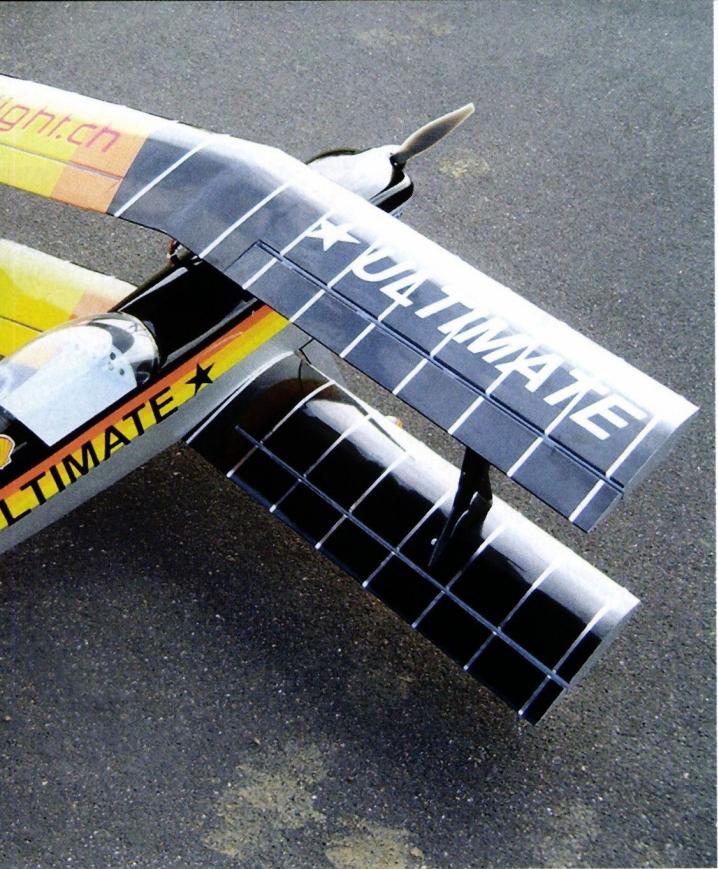
Okay, I’ll admit it—I had a little fling back then… About ten years ago, I wanted to compete in an F3A regional competition again; you just can’t dodge the judges’ criticism forever… Anyway, on the very first day of practice, I crashed my new aerobatic plane into the treetops during a landing approach because my glasses prescription had changed. That’s when Emil G. (or rather, his subsidiary Emil’s Aero-Leasing) lent me his electric aerobatic plane. It had about 30 NiCd cells, a Summi controller, a Plettenberg or Geist-Heuler motor with the classic 11×7¾ Zinger propeller or something like that. The thing even had retractable landing gear (a completely unknown brand...) and flew so well that I won the regional championship and then almost the inter-regional championship with it. You did have to fly this motor glider-like thing with real momentum, and use up the last of the battery power for the final spin to reach a reasonably safe starting altitude, and the final landing rectangle was about the size of a linen cloth—with a steady descent, of course. But it had something special. Yet nothing prepared me for what happened to me this summer. Having fallen into a state of lethargy, I was just drifting along with my model flying when I realized that I now essentially have my “own” double world champion with an electric model aircraft specialty shop (okay, not a real store, more of this new virtual stuff) right on my doorstep. “It’s running like a charm,” he says. “And you could definitely post something decent for a change.” “It’s all too expensive—I know, you’re all flying with those military ‘chocolate’ batteries that catch fire!” I say. Anyone who knows Urs better knows that behind his cool demeanor there’s quite a bit of tenacity—in any case, he won’t give up until I build my first electric aerobatic plane. What do I mean by “build”... Infinity by fliton, assembled in four evenings. AXI 4130/16, 6S1P 3200 Kokam, PHX80, APC 16×10—no idea what any of that is, but it was put together and installed by my personal guru, batteries charged unattended inside the model (which earned me a scolding from the grand master—not to mention a red card)—and from then on, I just flew it and was blown away. More power than before with a 15cc four-stroke, yet still lighter than with all that junk; endless torque; thanks to the direct drive, no gearbox whine like that 30-year-old hand blender in Mom’s kitchen... and about the same flight time as with 3 deciliters of good fuel. Holy cow! Then things really took off: Obsession 2×2 m, 2×5S1P 3700, PHX 110, Ultimate from eurolight at 1.4 m with Hyperion 4035, 5S1P3700; in between, for the fall, a Kyosho Calmato low-wing glider, also with Hyperion, but the 4025 model, also 5S1P 3700; and, as a quick fulfillment of an old dream, a twin-engine, P-38 Lightning, also from eurolight, 2.12 m, 7.5 kg, with 2 Hyperion 4035s and two ESCs (all models now, by the way, with 80A Opto ESCs—also Hyperion—they just work, no fiddling, no messing around with programming) ... I flew the Lightning on New Year’s Day, at 5 degrees below zero! No one believes me! Me at the airfield in winter. The last time that happened was when I was still out and about with my frozen Sachs moped, trailer, and Marabu!
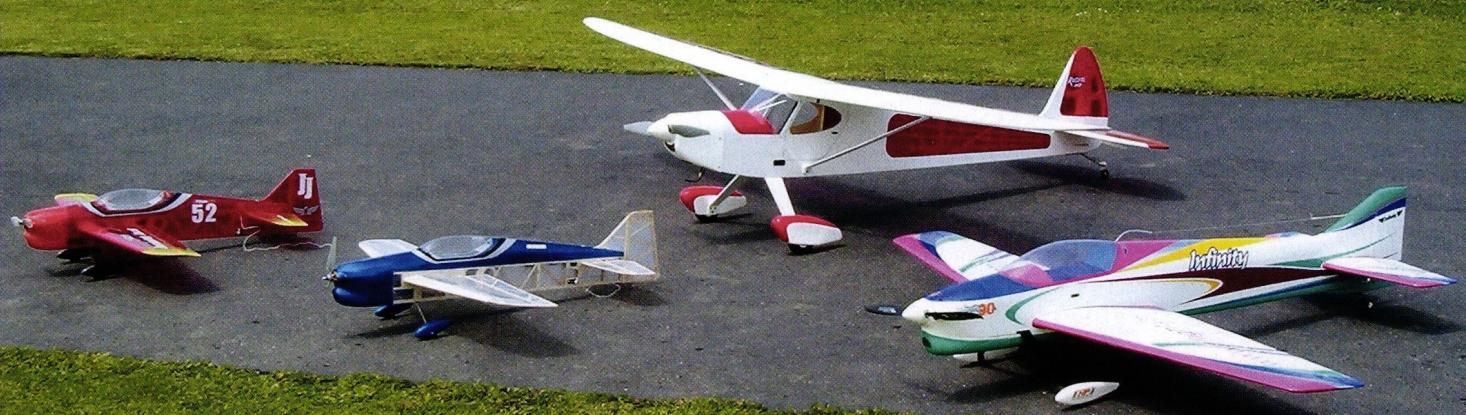
By now, I even dare to take my first tentative steps without my personal teacher and mentor—well, at least I’m poking around on his website and playing around with the e-calculator: If I take this new motor—which spins at 26,000 RPM on a 5S battery and drains the Polyquest in 3 minutes when mounted on an 8×8 pylon strut with exactly 25C—couldn’t I revive my old F3D parts? After all, those only ran for 2 minutes on 200 ml of FAI fuel...! In any case, there’s room for the batteries in the resorubber box, and I can get the center of gravity right that way—oh, what a wonderful new world!
What’s in it for you? Well, we’re learning that model flying never gets boring and that even old dogs can still be taught new tricks every now and then. These days, there’s little to nothing that doesn’t fly on electric power. And especially in the “economically sensible” weight range of 2.5 to 4 kg, there are no propeller-driven aircraft that couldn’t be successfully equipped with an AXI 41 or Hyperion 40. You have to pay a little attention to the center of gravity; you can choose all control surfaces one size smaller; the motor mounts, linkages, control horns, and hinges can be discarded in all kit sets except Fliton—they’re all too big, bulky, and heavy. With a little ZAP and carbon rods, the Migros Crystal tape that’s indispensable for electric model aircraft, and 1–2-mm fiberglass-reinforced plastic (FRP) sheets for control horns, you can glue, saw, and Dremel all your parts yourself. I’ve definitely noticed a shift: These days, people buy the plane ready-made, but they build their own accessories—the kind they used to buy pre-made from Kö, in small, expensive bags off that huge wall... By the way, I take a much more pragmatic view of ready-made models than some of the opinion leaders in model aviation... After all, Bode Miller doesn’t build his own skis either.
One more thing about costs. “Yeah, as a self-employed person, you can just switch to electric!” is something I’ve been hearing a lot lately. Well, I’m not saying it’s cheap. But in the long run, once the Schulze charger has slowly paid for itself in my mind—and the batteries, which, by the way, are all just generic 5S1P 3700s with a balancer connection (yeah, yeah, I know—only wimps balance them; real guys don’t…), aren’t even starting to lose their charge yet—that’s when it starts to make economic sense, too. When I think back to all those barrels of methanol, Castrol oil, and nitro, to all those OS-7 spark plugs, to the countless VDO fuel pumps, the perpetually faulty spark plug connectors and glow plugs… was that really cheaper, or just romantic?
Speaking of money. I have to stick up for the model industry here. In 1973, I saved up diligently for a whole year—setting aside 450 Swiss francs of my monthly apprenticeship pay—to buy a new Digi-Fly 5 from Mr. Frei in Hegnau. With 5 servos and reduced control surface travel (WOW!), it cost well over 2,000 Swiss francs. Today, a FUTABA FF9 PCM with 5 digital servos costs less than 1,000 Swiss francs if you’re a savvy shopper. It can do a lot more, doesn’t need summer and winter tuning (...!), and adjusted for inflation—not to mention my income—that’s about 10 times less. Back in 1973, you could still get a townhouse in Winterthur for 180,000.–! Back in the day, if you bought just the wood and covering material (that toxic-green-metallic Super-Monocote— remember that!) and the aforementioned small parts from the big wall, it cost more than it does today for a model built ready-to-fly in Thailand… and we capitalists even took that work away from low-wage countries! Let’s not hear anyone say that everything used to be better! Wishing you lots of fun with e-flying,
Roger Riedener

EURO CONTEST GLIDER ACRO TOUR AUSTRIA 2026

THE PC-21 STORY
 Emil Giezendanner

TWIN TOWN PARTNERSHIP
 Wolfgang Voeller

SUMMER FUN 2026 AT MG USTER
Martin Wunderli
CORSAIR F4U – A WARBIRD WITH A MEMORABLE LOOK
Jürgen Rosenberger, Jürgen Prinz
52. 2026 ALPS CUP
Emil Giezendanner
YOU KNOW WHAT I MEAN? 125 YEARS OF THE SWISS AERO CLUB
Emil Giezendanner
News from HEBU

TEAM MANAGER "THIS" BOSSHARD
Rodito Nussbaumer
ATOM, THE NEW DOUBLE-DECKER FROM CPLR
 Matthias Bosshard

F3A EUROPEAN CHAMPIONSHIPS IN ST-MACAIRE, FRANCE
Matthias Bosshard
INSIGHTS INTO THE HISTORY OF SEAPLANES

WELCOME, NEW MEMBER!
Andrea Bolliger
What's New at Leomotion.com

PRIDE AND GOOD IDEAS
 Markus Nussbaumer

SMALL, MODEL-LIKE SAILBOATS
Res Dauwalder
FREE FLIGHT IN THE MIDDLE OF SUMMER
Urs Muntwyler
BY YOUTH, FOR YOUTH
Lorena Betschen
HORIZON HOBBY/LEMACO NEWS: MICRO OV-10 BRONCO 645 MM BY E-FLITE

34th HAHNENMOOS ALPINE MODEL AIRPLANE CAMP
Res Dauwalder
COUPE DES ALPES – OBSERVE AND LEARN
Rodito Nussbaumer
TRY-OUT DAY AT MFV WETTINGEN
 Urs Keller

NEWS FROM HEBU
 Julia Bucher

NOS REGION – A HUB FOR ELECTRIC AVIATION
Emil Giezendanner
MEMORIES
 Wolfgang Völler

70 YEARS OF THE NIDWALDEN MODEL AIRPLANE CLUB
Martin Barmettler
A SPECTACULAR F3A WORLD CUP IN THE PRINCIPALITY OF LIECHTENSTEIN
Emil Giezendanner
FROM 0 TO 100
Markus Nussbaumer