
Yak 54 EP "40" by Hyperion at eflight.ch
The Yak 54 EP “40” from Hyperion is a thoroughbred aerobatic aircraft designed specifically for electric flight. The semi-scale ARF kit is very well-finished and manufactured with great care. After 6 to 8 hours of assembly, the Yak 54 is ready for its maiden flight.
Up until now, I’ve had electric models in the one-meter class. This winter, I wanted to try something a bit bigger. While searching for a suitable model, the selection was certainly large, but the vast majority of the models were designed for internal combustion engines and were therefore already heavier than necessary in their unpainted state. Then, on the forum at www.eflight.ch, I came across Hyperion’s latest plans: a Yak 54 with a 1,380-mm wingspan and a very sophisticated design—exactly what I had in mind. Unfortunately, the first batch of the Yak 54 was already sold out in February, and I had to wait until early March for the new shipment. On March 3, the moment finally arrived; I was holding it in my hands. The kit was neatly packaged and of the highest quality. When weighing the individual parts, it quickly became clear that the advertising hadn’t overpromised: a takeoff weight of 2,200 g to 2,400 g was well within the realm of possibility.
The assembly of the Yak 54 is explained briefly, simply, and clearly in ten pictures in a five-page assembly manual. Assembly is straightforward for both novice and experienced model builders. The parts fit together perfectly, requiring very little finishing work. The build essentially consists of attaching the control surfaces and stabilizers, and installing the RC and power components. I use four Hi-Tec HS-225MG standard servos, which fit perfectly into the designated servo wells and, with 38 N/cm of torque, provide more than enough power for the large control surfaces.
My finishing work is limited to “re-smoothing” two areas of film on the fuselage and one wing using a hot-air gun.
With today’s wide variety of motors, it’s not always easy to make a choice. When selecting one, I relied on the user-friendly “eMotor Calculator” at www.eflight.ch and the recommendation in the assembly instructions. The only requirement was that I be able to power the Yak 54 with my existing LiteStorm 2100 4s2p cells from my Aero L159 electric jet. It soon became clear that the Hyperion Z4020-14 motor would be a good choice. This motor can be powered by both 4S and 5S LiPo batteries and, with 700 to 900 W, offers enough power for 3D flying.
Ultimately, I decided on the Hyperion Z4020-14 paired with an APC E 16×8 propeller. This powerplant should deliver about 4.1 kg of static thrust at 60 A. With an APC E 16×10, it’s said to reach as much as 4.5 kg at 67 A. 5S powerplants deliver a static thrust of up to 5.2 kg at similar currents—brutal for a takeoff weight of 2300 g. Hyperion also offers a steel motor mount that is perfectly matched to the motor and the model. Only the weight of 138 g seems high at first glance. An aluminum mount would be slightly more advantageous. During installation, it quickly becomes apparent that the mount can be shortened further, saving a few extra grams. I also had to shorten the motor shaft by 11 mm to accommodate the Hyperion propeller spline, so that the propeller rotates as close as possible to the motor housing and vibrations are minimized. This brings the takeoff weight, including a dummy pilot, to exactly 2,340 g. The entire build took just eight hours.
For the aileron travel, I followed the assembly instructions more or less:
Ailerons: +/-27 mm, 30% Expo
; Elevator: +/-30 mm, 40% Expo
; Rudder: +/-65 mm, 0% Expo
. The center of gravity is specified as 115 mm from the leading edge. I read in model-building forums that a center of gravity of more than 115 mm results in a very lively Yak 54. So, to be on the safe side, I set the center of gravity to 110 mm for the maiden flight.
After a range test and a few taxiing runs, the Yak was “Ready for Take-off.” One last control check, a slow increase in throttle, and after a short roll, it soars unstoppably toward the sky. After a brief trim adjustment, I climb to a safe altitude to test the low-speed flight characteristics: stalling until the wing breaks over. With the elevator fully back, the Yak can be held without it breaking over one wing. So it handles absolutely well. Then it’s time for the approach to the first landing. With constant pull, it enters the final approach steadily, and after a somewhat long landing, the
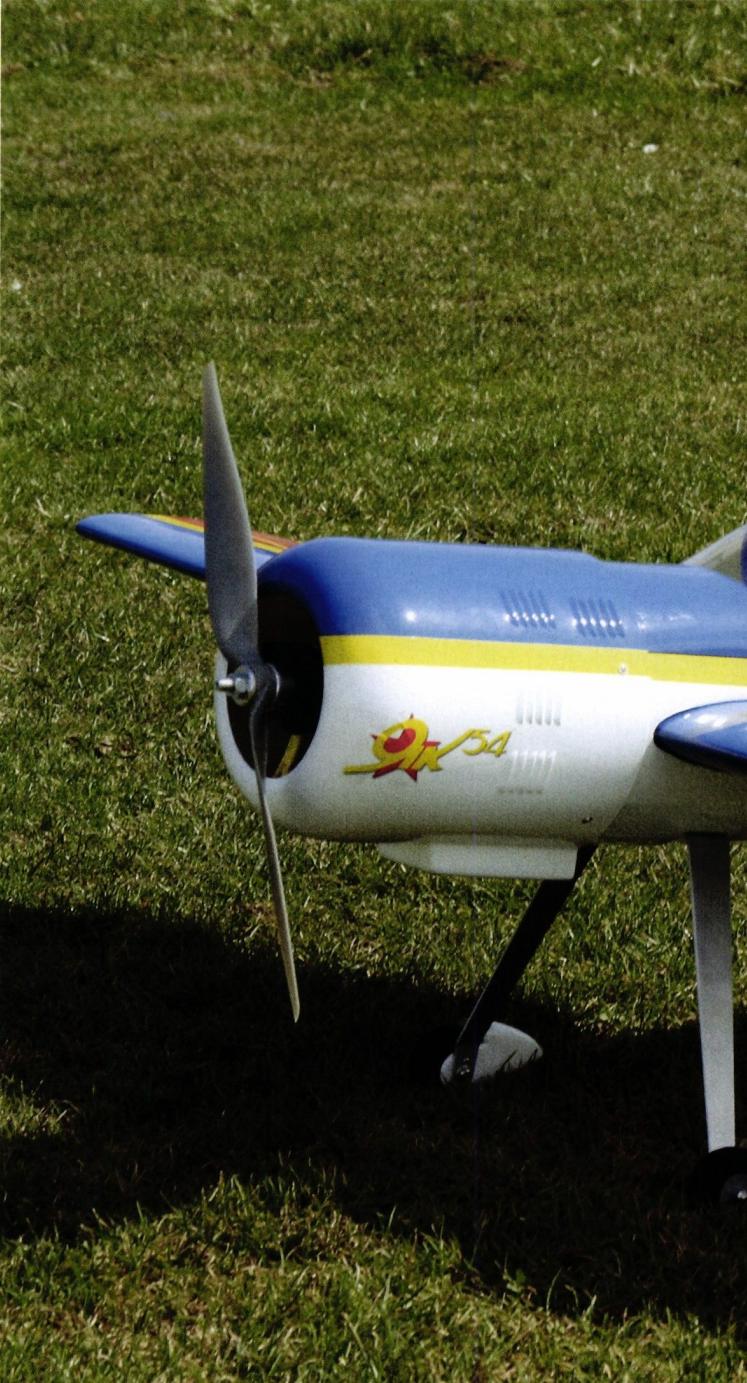
The Yak 54 is completely in its element ...
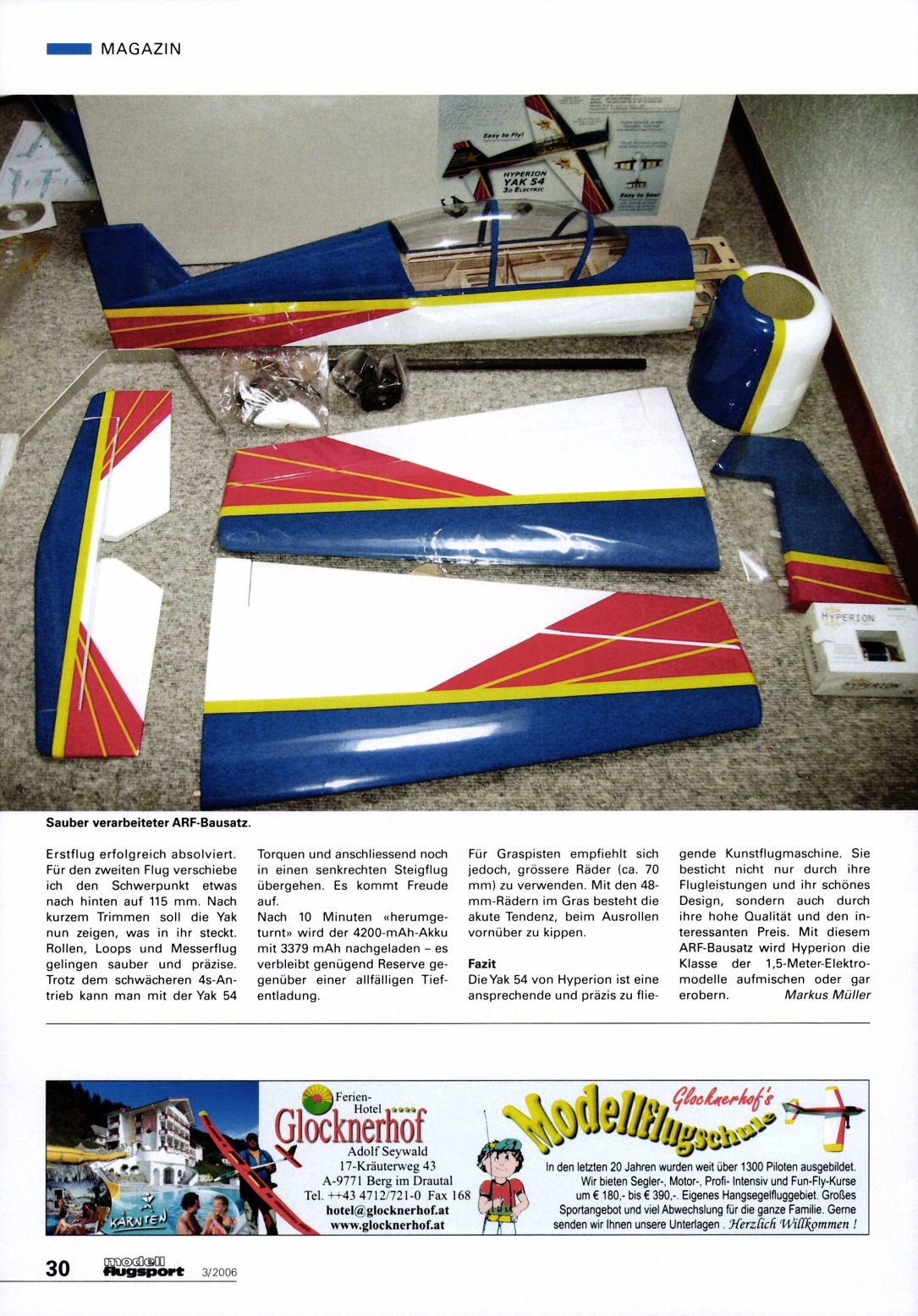
A well-finished ARF kit.
First flight completed successfully. For the second flight, I’m shifting the center of gravity slightly aft to 115 mm. After a quick trim adjustment, the Yak is now ready to show what it’s capable of. Rolls, loops, and inverted flight are executed cleanly and precisely. Despite the weaker 4S powerplant, the Yak 54
and then transition into a vertical climb. It’s a real joy.
After 10 minutes of “flying around,” the 4200-mAh battery is recharged to 3379 mAh—leaving enough reserve in case of a deep discharge.
For grass runways, however, it’s recommended to use larger wheels (approx. 70 mm). With the 48-mm wheels on grass, there’s a strong tendency to tip forward when coasting.
The Yak 54 from Hyperion is an appealing aerobatic aircraft that flies with precision. It impresses not only with its flight performance and beautiful design, but also with its high quality and attractive price. With this ARF kit, Hyperion is set to shake up—or even conquer—the 1.5-meter electric model class. Markus Müller

EURO CONTEST GLIDER ACRO TOUR AUSTRIA 2026

THE PC-21 STORY
 Emil Giezendanner

TWIN TOWN PARTNERSHIP
 Wolfgang Voeller

SUMMER FUN 2026 AT MG USTER
Martin Wunderli
CORSAIR F4U – A WARBIRD WITH A MEMORABLE LOOK
Jürgen Rosenberger, Jürgen Prinz
52. 2026 ALPS CUP
Emil Giezendanner
YOU KNOW WHAT I MEAN? 125 YEARS OF THE SWISS AERO CLUB
Emil Giezendanner
News from HEBU

TEAM MANAGER "THIS" BOSSHARD
Rodito Nussbaumer
ATOM, THE NEW DOUBLE-DECKER FROM CPLR
 Matthias Bosshard

F3A EUROPEAN CHAMPIONSHIPS IN ST-MACAIRE, FRANCE
Matthias Bosshard
INSIGHTS INTO THE HISTORY OF SEAPLANES

WELCOME, NEW MEMBER!
Andrea Bolliger
What's New at Leomotion.com

PRIDE AND GOOD IDEAS
 Markus Nussbaumer

SMALL, MODEL-LIKE SAILBOATS
Res Dauwalder
FREE FLIGHT IN THE MIDDLE OF SUMMER
Urs Muntwyler
BY YOUTH, FOR YOUTH
Lorena Betschen
HORIZON HOBBY/LEMACO NEWS: MICRO OV-10 BRONCO 645 MM BY E-FLITE

34th HAHNENMOOS ALPINE MODEL AIRPLANE CAMP
Res Dauwalder
COUPE DES ALPES – OBSERVE AND LEARN
Rodito Nussbaumer
TRY-OUT DAY AT MFV WETTINGEN
 Urs Keller

NEWS FROM HEBU
 Julia Bucher

NOS REGION – A HUB FOR ELECTRIC AVIATION
Emil Giezendanner
MEMORIES
 Wolfgang Völler

70 YEARS OF THE NIDWALDEN MODEL AIRPLANE CLUB
Martin Barmettler
A SPECTACULAR F3A WORLD CUP IN THE PRINCIPALITY OF LIECHTENSTEIN
Emil Giezendanner
FROM 0 TO 100
Markus Nussbaumer