
Aerobatics
A major challenge when getting started in model flying is the fact that the control commands on the remote control are based on the model’s axes, but the model’s position relative to the pilot is constantly changing. For example, when the model is approaching, you must steer left if you want it to fly to the right from your perspective, and if the model is flying upside down, you must apply elevator to make it climb.
Beginners in model flying need quite a few flights before the necessary “shift in thinking” becomes automatic during normal flight operations. Aerobatic pilots must master this in a flash, even during the rapid succession of extreme flight attitudes.
In addition, the aerobatic pilot needs a particularly deep understanding of the forces that influence the model’s flight path depending on the flight condition. This begins as early as the test flight of the competition model, which should behave as consistently as possible in all flight attitudes.
Aerobatic competitions require pilots to fly a combination of figure programs—some known in advance and others released only at the time of the competition—as precisely as possible. At some events, pilots also fly routines they have developed themselves. Occasionally, music and smoke are used as well.
The pilot is assisted by a spotter standing behind him, who reminds him of the maneuvers to be flown and alerts him to necessary corrections—such as staying within the designated airspace. A good assistant also provides emotional support to the pilot, as even the smallest “nervous” mistake can result in the loss of several places in the rankings.
Each maneuver is judged by a panel of judges who detect even the slightest deviations from the ideal maneuver. Only those who have mastered the routine and every maneuver with confidence—and can correct for wind effects as elegantly as possible—stand a chance. Intensive training is essential for this!
Today, powered aerobatics is flown in a wide range of classes. The most important international discipline is F3A, which uses models weighing a maximum of 5 kg and with a wingspan of approximately 2 meters. The models are powered by extremely quiet methanol and gasoline engines, as well as electric motors, which now deliver breathtaking performance. The Matt brothers from Liechtenstein are among the world’s best in this field.
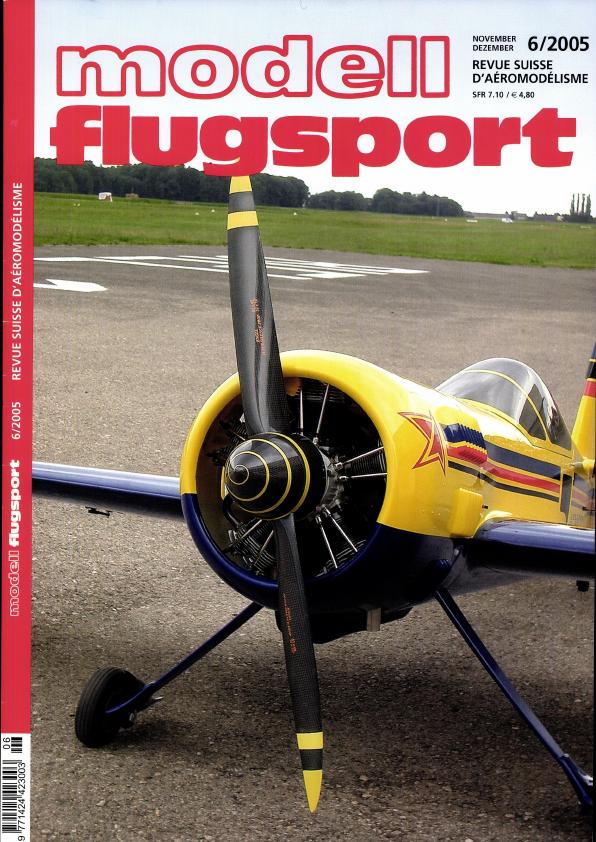
One specialty is large-scale aerobatics with multi-cylinder gasoline engines up to 200 ccm. These replicas of large aerobatic aircraft, with a wingspan of approximately 3 meters, are often flown with smoke, just like the originals. Typical maneuvers include extremely tight acrobatic moves and figures in which the model, suspended vertically from the propeller, rotates around its longitudinal axis just a few centimeters above the ground.
Small and extremely lightweight models made of Depron—a material similar to Styrofoam—are becoming increasingly popular; thanks to their electric motors and extreme maneuverability in tight spaces, they can even be flown in gyms. For some enthusiasts, even the living room serves as a flying arena!
Glider aerobatics can be practiced both in good updrafts on a hillside and on flat terrain.
In aerobatics competitions, the gliders are towed to an altitude of several hundred meters by remote-controlled tow planes.
Once the tow line is released, the only source of propulsion is the potential energy stored in the glider. This energy must be gradually dissipated while performing the required maneuvers, which demands a keen sense of the glider’s current speed. Taking the wind into account is essential in this process.
The models used are replicas of manned aerobatic gliders with a wingspan of up to approximately 6 m and a maximum weight of 20 kg.
Particularly popular with pilots and spectators are the freestyle routines, which are flown to music with smoke cartridges. The “Swiss Akro Connection” meets once a week from spring through fall to practice these now highly demanding routines.
*As the year comes to a close, we wish our subscribers,
advertisers, and authors a successful New Year.*
*Editorial Staff and Publisher*


EURO CONTEST GLIDER ACRO TOUR AUSTRIA 2026

THE PC-21 STORY
 Emil Giezendanner

TWIN TOWN PARTNERSHIP
 Wolfgang Voeller

SUMMER FUN 2026 AT MG USTER
Martin Wunderli
CORSAIR F4U – A WARBIRD WITH A MEMORABLE LOOK
Jürgen Rosenberger, Jürgen Prinz
52. 2026 ALPS CUP
Emil Giezendanner
YOU KNOW WHAT I MEAN? 125 YEARS OF THE SWISS AERO CLUB
Emil Giezendanner
News from HEBU

TEAM MANAGER "THIS" BOSSHARD
Rodito Nussbaumer
ATOM, THE NEW DOUBLE-DECKER FROM CPLR
 Matthias Bosshard

F3A EUROPEAN CHAMPIONSHIPS IN ST-MACAIRE, FRANCE
Matthias Bosshard
INSIGHTS INTO THE HISTORY OF SEAPLANES

WELCOME, NEW MEMBER!
Andrea Bolliger
What's New at Leomotion.com

PRIDE AND GOOD IDEAS
 Markus Nussbaumer

SMALL, MODEL-LIKE SAILBOATS
Res Dauwalder
FREE FLIGHT IN THE MIDDLE OF SUMMER
Urs Muntwyler
BY YOUTH, FOR YOUTH
Lorena Betschen
HORIZON HOBBY/LEMACO NEWS: MICRO OV-10 BRONCO 645 MM BY E-FLITE

34th HAHNENMOOS ALPINE MODEL AIRPLANE CAMP
Res Dauwalder
COUPE DES ALPES – OBSERVE AND LEARN
Rodito Nussbaumer
TRY-OUT DAY AT MFV WETTINGEN
 Urs Keller

NEWS FROM HEBU
 Julia Bucher

NOS REGION – A HUB FOR ELECTRIC AVIATION
Emil Giezendanner
MEMORIES
 Wolfgang Völler

70 YEARS OF THE NIDWALDEN MODEL AIRPLANE CLUB
Martin Barmettler
A SPECTACULAR F3A WORLD CUP IN THE PRINCIPALITY OF LIECHTENSTEIN
Emil Giezendanner
FROM 0 TO 100
Markus Nussbaumer