
Glider Aerobatics Like Never Before
Never before has there been as much activity in sailplane aerobatics as there was during the 2004 season. The two regional competitions in Geiss (RMV 3) and Hinwil (NOS), the Swiss Acro Cup in Hinwil, and the first-ever official Swiss Championship in Thun combined for a total of 15 runs for the 89 competitors. This resulted in 334 flights from altitudes of 400 or 500 meters. In total, that amounts to 150,300 meters—or over 150 kilometers (!!)—which the tow pilots pulled the gliders over in 2004 and which were then quickly “destroyed” by the aerobatic aircraft.
If that wasn’t enough, participants also had the opportunity to attend three competitions abroad: starting in Vienna, continuing through Feistritz an der Gail, and culminating in the international highlight, the German Championship in Lauterbach.
Some of the SAC pilots participated in many of these competitions. However, no one was able to attend all the events in 2004. I would therefore like to take this opportunity to provide a chronological review of the past season.
Despite adverse weather conditions, 18 pilots competed in two rounds to determine the regional champion. Adrian Eggenberger of MSV Stetten handled the strong winds best and took first place ahead of Philipp Schürmann and Thomas Hoffmann. However, the competition came to an end after two rounds. Another round would not have been reasonable, especially for the tow pilots. Roman Ledergerber and Urs Schuppisser had already commendably risked their models to make the event possible in the first place. It was only thanks to their extensive experience that damage was avoided.
The infrastructure for the Swiss Akro Cup was set up in Hinwil a weekend earlier and used for the regional competition. At the same time, this provided the 13 participating pilots with a welcome opportunity to train for the SAP. Rolf Kessler seized the opportunity and showed everyone just how well he’s already handling his new model, the 5-meter Kobuz from Airworld, and won the championship title. This title was long overdue, as Rolf consistently demonstrates his true potential during training sessions. It’s just that things never quite clicked for him in competition until now. Peter Gafner and Thomas Hoffmann followed in second and third place, respectively.
This was the third time the international competition had been held. And for the second time, the participants were able to count on the hospitality of MG Hinwil. Unfortunately, the weather this year was nowhere near as good as it had been during the “summer of the century” in 2003. In the end, however, the weather gods relented, and thanks to extended breaks in the rain, the 44 participants in total did not make the trip in vain. Aerobatics fans from Austria, the Netherlands, Germany, and, of course, Switzerland made their way to Hinwil. All participants were then able to fly four rounds, and in the end, last year’s winner, René Weisshäupl, confidently defended his title. Unfortunately, no Swiss pilot was able to prevent an all-Austrian podium this year. Author Andi Schaerer was left with the thankless fourth place.

behind Gerhard Tuma and Hans Wallner in second and third place.
In the beginners’ class, Gerd Vollenweider once again managed to hold off the strong international competition and claim the title.
The organizing committee and all the volunteers from MG Hinwil impressively demonstrated this year that they are a very well-coordinated team. Pulling off such a large competition smoothly under these weather conditions is anything but easy. Many thanks to the entire MG Hinwil team for their tireless dedication to aerobatic sailing.
We hope that we can count on MG Hinwil once again in 2005.
It was a long road before the glider aerobatics community was finally granted permission to host an official Swiss championship for the first time. The first step was to convince the SMV of the seriousness of glider aerobatics activities and to demonstrate continuity through several regional events over a two-year period.

to demonstrate. There was great fear that it would be a flash in the pan—something that flares up briefly only to be smothered soon after.
In addition to the federation, the challenge was to find a club willing to host the Swiss Championships. We found one in the form of MG Thun, and
so everything was finally set to hold the first official Swiss Championship on a Saturday in October. The weather forecast, however, was so bad that numerous participants called Thun in disbelief early Saturday morning before setting out, saying we
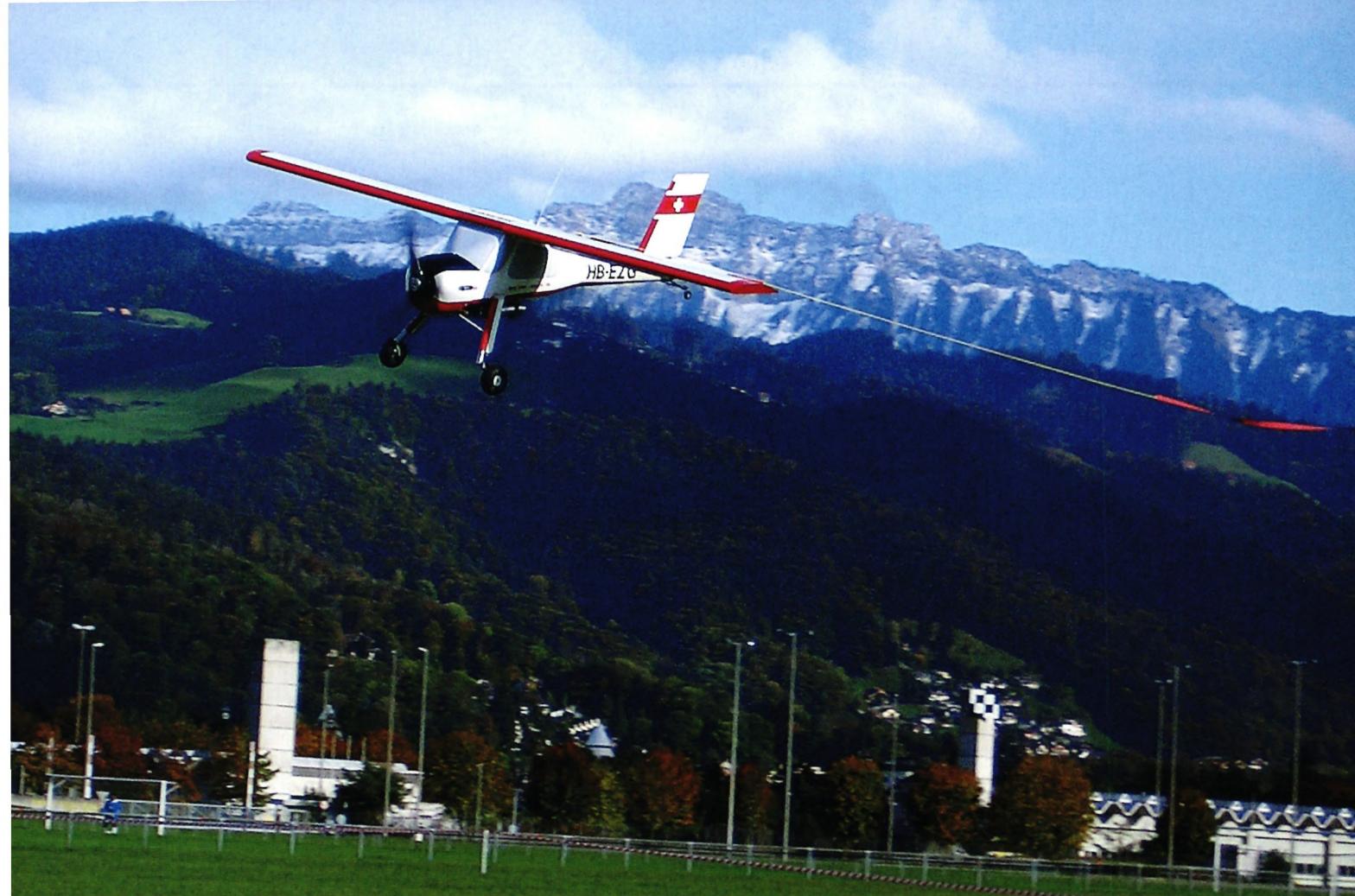
must be out of our minds to start the competition in such weather. These reactions were perfectly understandable. After all, it was pouring rain in large parts of Switzerland at that time. In Thun, however, a Föhn window provided wonderful weather. Early in the morning, it was still so cold that ice formed on the wings as the models were being set up. But soon the autumn sun warmed the participants’ faces and spirits, and so the Swiss Championship turned into a wonderful highlight of the season. The 14 participants competed in a total of five rounds for the coveted championship title. Only the programs of the international class were flown. The total of 14 participants corresponded exactly to the pilots who had competed in the International Class during the 2004 season. Holding an additional competition in the Sport Class would have exceeded the scope of a one-day event.
From the very beginning, the favorites—Alois and Philipp Schürmann, Adi Eggenberger, and Andi Schaerer—engaged in a neck-and-neck race at a very high level. Unfortunately, Alois Schürmann experienced reception problems in the third round, which—in addition to fraying his nerves—certainly cost him a few points. Actually, he wanted to—
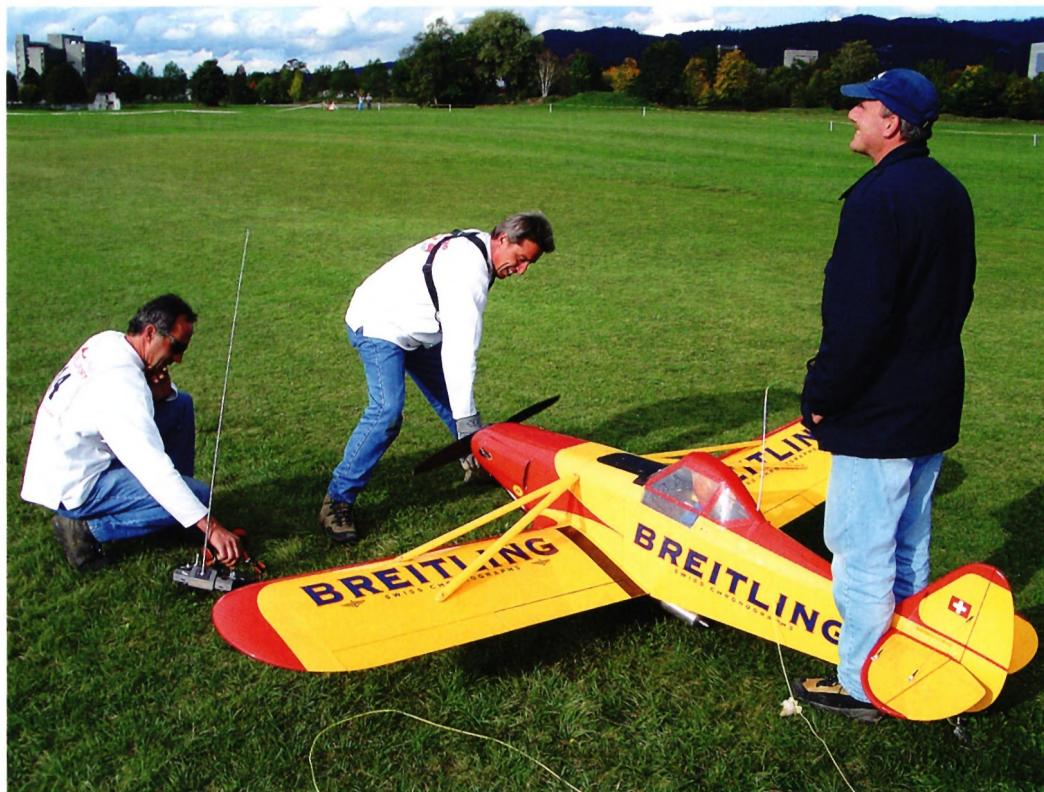
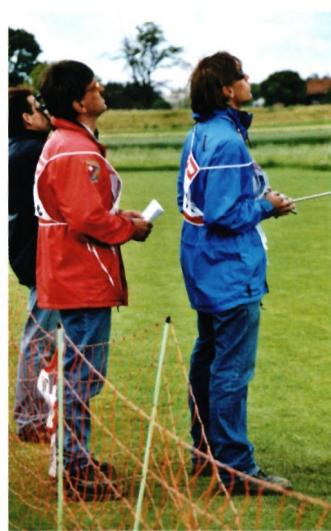
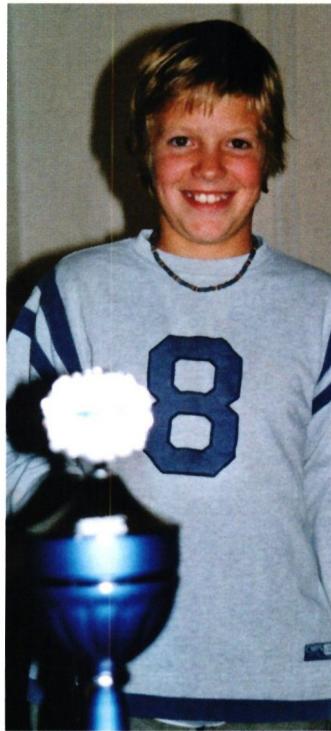
Alois couldn’t even compete in the finals because he couldn’t identify the cause of the interference. However, a test run on the common land adjacent to the airfield led him to discover three RC car drivers, one of whom was promptly using the same frequency as Alois. This allowed Alois to calmly repeat the fourth run, promptly scoring 1,000 points, and—going into the freestyle round just a hair behind leader Andi Schaerer—he was suddenly back in contention for the title. The freestyle round promised to be highly exciting. An approaching storm front added to the pilots’ nerves. After all, a Swiss championship title was at stake. After a very strong freestyle run by Alois, it was clear that Andi couldn’t afford to slip up in his freestyle run. But he kept his cool, and Andi Schaerer was able to secure the 1,000-point mark—and thus the title of the first Swiss Champion in glider aerobatics—ahead of Alois Schürmann with a very strong flight. Adi Eggenberger relied on new, homemade smoke flares for his freestyle routine, which unfortunately didn’t work properly. Distracted by this and a brief rain shower, his flight wasn’t really good, and so Adi had to settle for 4th place in the final standings behind Philipp Schürmann. Our youngest pilot, Tim Schaerer (11), placed fifth. A very good result for Timi. The real surprise was newcomer Silvio Meier, who placed sixth in his very first competition. If Silvio sticks with it, we’re sure to hear a lot more from him. After the awards ceremony at a nearby inn, the celebrations continued late into the night. A fitting end to a wonderful season.
As agreed at the international coordination meeting, the new programs for 2005 and 2006 were to come from
Switzerland. So we tinkered and sketched. Then we tested them at the airfield, made changes, and tested them again. The result is a set of new compulsory routines for the International and Beginner classes, which we’ll now take a closer look at:
The routine begins with a center figure in the center of the flight box. A half roll exactly in the center, followed by a full loop. The exit is then performed in the inverted position.
In the back position, the pilot then moves into the first turn: a vertical descent with a right-angle exit in a positive attitude—essentially a half-square loop. The goal now is to maintain speed for the next maneuver.
The Cobra Roll. From the positive approach, the pilot pulls up 45°. After a brief flight phase, a half roll follows. In
From the back position, continue climbing 45° up to the center of the box. There, pull vigorously until the model flies down at a 45° angle. Halfway through the flight path, perform another half roll back into the positive attitude. The exit is also positive. The next turning maneuver is a ½ Cuban Night: pull off a ¾ loop until the model flies downward at a 45° angle on its back. Then
a half roll during the descent, with a positive exit. Now, as the fifth maneuver, a wind-offset maneuver follows—a positive hat with ¼ rolls up and down in the center of the box. Depending on the desired offset, the upward roll is turned to the right or to the left. At the top, there is a brief phase of flight on the back before descending vertically again. The direction of rotation for the downward roll is the same as that of the upward roll.
The next turning maneuver is a classic turn. Positive exit. Make sure to maintain a nice vertical climb and descent, and don’t miss the right moment to apply the rudder. If you’re unsure, you can fly the vertical legs a bit flatter—around 80°. This will result in a slight deduction—but it’s still better than a zero. You’ll get a zero if the turn flips over.
The final maneuvers consist of two half rolls in the same direction of rotation. The two half rolls are interrupted by a brief phase of inverted flight in the center of the box.
The landing consists of a 90° crosswind approach and a final approach. Before touching down, a clear flare must be recognizable—
First, fly a half roll exactly in the center of the box. Shortly thereafter, steer the model into a drawn ¾ loop. In the middle of the 45° climb, perform a half roll into an inverted flight. Exit in a negative direction. Fly the loop
should be flown nice and big so there’s enough speed for the 45° climb.
Next, perform a downward Humpty with a half roll down. Exit negative.
Make sure there’s enough speed so that the vertical climb can be flown clearly. However, don’t use so much speed that the airframe stalls in the tight lower recovery arc. Negative deviation.
The center figure is now 1¼ rotations of a back spin.
Movement into the room. Spin to the left or right, depending on the desired direction of movement (away from you or toward you). Negative departure (finally!). But before the departure, build up some speed—we’ll need it for the next wonderful maneuver. This tricky maneuver has the highest difficulty rating (33): a backflip into the air, followed by a ¾ roll back to normal flight after the negative recovery. The model is still flying at a 90° angle to the flight axis, either toward you or away from you. From normal flight, perform a pulled Cover Leaf into inverted flight (Yay—inverted flight at last!) and back to the original flight axis. It takes some getting used to from this perspective, but with a little practice, it works quite well. From inverted flight (preferably nice and slow), as a turn maneuver, pull the elevator hard until the model flies in a positive attitude at a 45° angle away from you
. A half roll into inverted flight, and now build up some speed for the next maneuver. The exit is negative, of course. In the middle, a nice Cuban Night. To make it a bit more challenging, though, we’ll do the whole thing on our backs. At the second apex, we’ll skip the half roll and fly out in a positive attitude for a change (yes—P O S I T I V E—you read that right). As the final maneuver, a ¼ roll circle with a full roll. But not inward as usual—instead, turning nicely outward. It’s important to apply strong rudder input here—but to the correct side. Another positive flight (yawn...) After all that stress, it’s time for the landing. At first, we wanted to fly this one negatively, too. But after some trial and error, we think the conventional method makes more sense after all. So, that’s it—have fun practicing.
| April 1–3, 2005 | SAC Trip to Ticino |
| Starting April 21, 2005 | SAC training according to a separate training schedule |
| May 7, 2005 | RM Aerobatics Competition RMV 3, MG Zugerland |
| June 17–19, 2005 | Swiss Acro Cup, Hinwil, Switzerland (part of the Euro Tour) |
| July 2, 2005 | RM Glider Aerobatics NOS, MG Buttikon |
| September 17 or 24, 2005 | 2nd Official Swiss RCS Acrobatic Championships (location to be announced) |
| November 26, 2005 | SAC Winter Meet |
There have been recurring discussions because, in some cases, the authors of the “unknown” programs actually competed in the contest themselves and may have had an advantage as a result. That is why, for the first time, all pilots will now serve as authors for the “unknown” programs. The necessary information was sent out via email at the beginning of the year, so anyone can try their hand at writing an “Unknown” program and submit it to the pool. It makes sense to also
test it in practice to ensure it works properly. You’ll quickly see that it’s not at all easy to write a well-balanced program that can be flown well from the available altitude and also includes enough challenges. At each competition, the required number of programs is drawn from a pool of approximately 30–40 “unknowns” and flown.
| April 16–17, 2005 | Introductory seminar and training weekend in Hammersbach. |
| May 27–29, 2005 | International Sailplane Aerobatics Competition in Wasenbruck near Vienna (part of the Euro Tour) |
| July 22–24, 2005 | International Glider Aerobatics Competition in Feistritz an der Gail, Austria (part of the Euro Tour) |
| September 2–4, 2005 | DM Glider Aerobatics in Pösing, Bavaria, Germany (part of the Euro Tour) |
All the latest information is available from the author Andi Schaerer sac_info@modellflug.ch Or on the Swiss Akro Connection website www.modellflug.ch/sac
| Character Description | Aresti | K | |
|---|---|---|---|
| 1 | ½ 5/8 loop, negative exit |  | 26 |
| 2 | Humpty down with a ½ roll down, negative swing |  | 19 |
| 3 | 1¼ back spin, exit into space, negative exit |  | 18 |
| 4 | Back somersault with 2/4 rolls immediately after catching, positive flight into space |  | 33 |
| 5 | Clover leaf, negative exit |  | 20 |
| 6 | 45° descent with a half roll, negative flight path |  | 20 |
| 7 | Negative Cuban loop with a ½ roll at the first intersection point |  | 29 |
| 8 | ¼ roll circle with 1 roll outward, extension into the space |  | 24 |
| 9 | Landing |  | 10 |
| Space division | 20 | ||
| Harmony | 20 |
| Character Description | Aresti | K | |
|---|---|---|---|
| 1 | ½ rolled loop, negative exit |  | 15 |
| 2 | Vertical pull-through |  | 10 |
| 3 | Cobra roll with one ½ roll each, direction of rotation arbitrary |  | 29 |
| 4 | ½ Cuban Night | 16 | |
| 5 | Hat with ¼ up and down (wind shift) |  | 30 |
| 6 | Gymnastics |  | 17 |
| 7 | 2 half rolls, in the same direction of rotation, distinct backflip sequence |  | 17 |
| 8 | Landing |  | 10 |
| Spatial orientation | 20 | ||
| Harmony | 20 |
- It is possible to change models during the competition without losing airworthiness.
- In the Sport Class, the release altitude for the set and unset mandatory flights is a maximum of 400 m, and for the freestyle flight, a maximum of 500 m. In the International Class, the release altitude is a maximum of 500 m in all rounds. A new rule is that a competition official (a neutral person) monitors the release altitudes (subjectively and using a variometer receiver).
- The landing direction may be chosen freely, regardless of the direction in which the program began. This is primarily for safety reasons.
- Freestyle: Variety Points: A pilot receives full points (10 points) if he performs at least one maneuver from each of the following maneuver families in his freestyle routine: 1. Lines and angles / 2. Circles and rolling circles / 3. Spins / 4. Turns / 5. Inversions / 6. Loops and figure-eights / 7. Rolls and snap rolls. So, don’t forget to include spins and an inversion. If the inversion tips over, it’s just a turn—but it should work on the second try.
- Number of maneuvers in the freestyle routine: In both classes, a minimum of 7 maneuvers plus the landing must be performed. If the minimum number is not met, the entire routine will be scored as 0.
| Rank | Last Name | First Name | Last Name, Club | Total Points | Sailor |
|---|---|---|---|---|---|
| 1 | Schaerer | Andi | MSV Stetten | 3,959.1 | Swift 5.8 m, 19.5 kg |
| 2 | Schürmann | Alois | MSV Reusstal | 3,899.4 | Swift 4.8 m 13 kg |
| 3 | Schürmann | Philipp | MSV Reusstal | 3,786.7 | Swift 4.8 m 13 kg |
| 4 | Eggenberger | Adrian | MSV Stetten | 3,761.0 | Swift 4.7 m 13 kg |
| 5 | Schaerer | Tim | MSV Stetten | 3,664.0 | Fox 4m, 9.5kg |
| 6 | Meier | Silvio | MFG Falknis | 3,591.7 | Fox 5.6 m 17 kg |
| 7 | Schmid | Adrian | MG Worb | 3,463.3 | Fox 5m, 12kg |
| 8 | Schuppisser | Peter | MG Zurich | 3,359.8 | Swift 5.8 m 18 kg |
| 9 | Hoffmann | Thomas | MG Wehntal | 3,352.7 | Celstar 5m 13Kg, homemade |
| 10 | Klingenmeier | Roger | MG Wehntal | 3,250.1 | Swift 3.6 m 6.5 kg |
| 11 | Kessler | Rolf | MG Hinwil | 3,209.9 | Kobuz 5.1 m 17.6 kg |
| 12 | Fedrizzi | Bruno | MG Bassersdorf | 3,186.1 | Fox 4.7 m 13 kg |
| 13 | Ritzmann | Thomas | MG Zurich | 3,161.4 | Swift 4.7 m 11–14 kg |
| 14 | Geelhaar | Martin | MFG Fehraltdorf | 2,824.4 | Fox 4.7 m 11 kg |
| Last Name | First Name | Last Name, Club | Tow Plane |
|---|---|---|---|
| Jaberg | Christoph | MG Schöftland | Wilga 2.9m, 3W-120 |
| Schuppisser | Urs | MG Zurich | ST 140, Pawnee 160 |
| Bruggisser | Thomas | MG Zurich | Wilga 2.9 120cc |

EURO CONTEST GLIDER ACRO TOUR AUSTRIA 2026

THE PC-21 STORY
 Emil Giezendanner

TWIN TOWN PARTNERSHIP
 Wolfgang Voeller

SUMMER FUN 2026 AT MG USTER
Martin Wunderli
CORSAIR F4U – A WARBIRD WITH A MEMORABLE LOOK
Jürgen Rosenberger, Jürgen Prinz
52. 2026 ALPS CUP
Emil Giezendanner
YOU KNOW WHAT I MEAN? 125 YEARS OF THE SWISS AERO CLUB
Emil Giezendanner
News from HEBU

TEAM MANAGER "THIS" BOSSHARD
Rodito Nussbaumer
ATOM, THE NEW DOUBLE-DECKER FROM CPLR
 Matthias Bosshard

F3A EUROPEAN CHAMPIONSHIPS IN ST-MACAIRE, FRANCE
Matthias Bosshard
INSIGHTS INTO THE HISTORY OF SEAPLANES

WELCOME, NEW MEMBER!
Andrea Bolliger
What's New at Leomotion.com

PRIDE AND GOOD IDEAS
 Markus Nussbaumer

SMALL, MODEL-LIKE SAILBOATS
Res Dauwalder
FREE FLIGHT IN THE MIDDLE OF SUMMER
Urs Muntwyler
BY YOUTH, FOR YOUTH
Lorena Betschen
HORIZON HOBBY/LEMACO NEWS: MICRO OV-10 BRONCO 645 MM BY E-FLITE

34th HAHNENMOOS ALPINE MODEL AIRPLANE CAMP
Res Dauwalder
COUPE DES ALPES – OBSERVE AND LEARN
Rodito Nussbaumer
TRY-OUT DAY AT MFV WETTINGEN
 Urs Keller

NEWS FROM HEBU
 Julia Bucher

NOS REGION – A HUB FOR ELECTRIC AVIATION
Emil Giezendanner
MEMORIES
 Wolfgang Völler

70 YEARS OF THE NIDWALDEN MODEL AIRPLANE CLUB
Martin Barmettler
A SPECTACULAR F3A WORLD CUP IN THE PRINCIPALITY OF LIECHTENSTEIN
Emil Giezendanner
FROM 0 TO 100
Markus Nussbaumer