
Scale F4C, F4J, and F4L 2002
It’s Saturday, October 26, 4:00 a.m. Time to get up. Dominic is registered for the SM Scale competition in the Large category in Interlaken. A slice of bread and a glass of orange juice for breakfast, then we load the plane. The batteries weren’t fully charged the night before. We set off at 4:30 a.m. The roads are wet, and twigs and branches are scattered everywhere from the nighttime squalls. It doesn’t look good. We were already in Interlaken back in August. It rained nonstop for two days. The result was major flooding. 5:00 a.m.: The news. The gusts are supposed to ease up a bit as the day goes on. Well, as long as we don’t end up driving three hours for nothing again.
There’s an accident past the Walliseller Kreuz. We get through without hitting any traffic. Strong gusts keep shaking the car. Sven Epiney from Radio DRS is trying to keep spirits up. Six o’clock: News. The weather is supposed to improve somewhat as the day goes on. Some mountain passes had to be closed due to 30 cm of snow. In Moscow,
The hostages at the musical theater have been freed. There may have been some fatalities. But we’re making good progress. On the way to Bern, we stop briefly at a rest stop to finally have a coffee with fresh croissants. Seven o’clock: the news. There may have been several fatalities in Moscow. The gusty winds are dying down a bit. The sky is clearing up. We arrive at the Interlaken airfield right on time at half past seven. There’s already a lot of activity in the hangar. A refreshment stand has been set up on the left side, while on the right, the pilots are assembling their models. First, we go around to greet all our colleagues. Fortunately, so many were able to clear their schedules for the event once again. We hand in our transmitters and pick up our start numbers. The briefing is at 8:00 a.m.
Competition director Jörg Sterchi introduces his team and provides a few more explanations. 8:30 a.m. The competition begins. F4C flies the first round in slightly lighter winds. Six pilots are still competing. Reigning world champion Andreas Lüthi and local World Championship participant Max Schilt are visibly satisfied with their scoring flights and then decide to forgo a second flight to help keep the competition moving smoothly. At the same time, the helicopter competition is already underway on a taxiway. In this category, only five of the nine pilots who initially entered the build evaluation have flown. That’s a real shame, of course, because the models these pilots brought in for judging were of the very highest quality. The jets are the third category to fly. Unfortunately
In the meantime, since the first day of competition, two pilots have lost their aircraft, which had already been evaluated during construction. The gusts grew stronger again, causing quite a bit of shaking during several flyovers and making it more difficult to land cleanly in front of the judges. Here’s one such incident. Roger Thomas’s F-15 suffered a flameout while flying inverted against the wind, of all things. He tried to bring the plane down at an angle. It was half a meter short. The plane slammed into the asphalt and was catapulted back into the air. After gliding a hundred meters, Roger set it down gently on the grass.
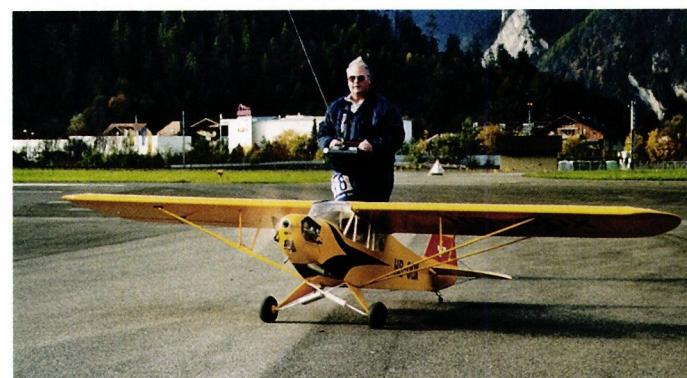
Now for the first round in the Large Scale category. Paul Haller flies his Skyraider precisely through the maneuvers. But the wind is getting stronger and stronger. His landing gear is damaged on landing. Then it’s Peter Anliker’s turn with the Piper. The gusts become so strong that he has to make several landing attempts. The competition director records wind force eight. Peter sets the Piper down, but the wind catches it again and flips it onto its back. That’s a real shame, because this aircraft had the second-best build score. The competition is suspended. After a break, the jet pilots volunteer to complete the second round with their fast aircraft. They need the results because they still have to select the team for the World Championships in South Africa. The competition director gladly accepts the offer. The wind continues to die down. The round goes off without a hitch. Then the missed flights in the Large Scale category are made up under fairly good conditions. Back in the office, the computers are running hot as rankings are compiled and certificates are drafted. Some pilots pass the time by flying, while others pack up their models or wait for the results in the festival tent over sausages and coffee.
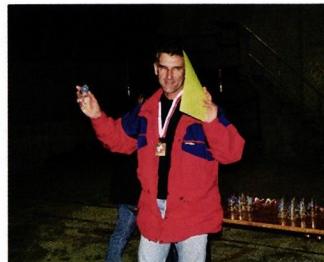
Jürg Sterchi asks for quiet for the announcement of the results. He thanks the pilots for their discipline and for showing up. But the real thanks go to Jürg and his team from MG Interlaken for once again setting up the infrastructure and for their excellent work throughout the entire competition. For once, this isn’t about filling the coffers, but about work for the association and the pilots—work that simply has to be done once a year by kind-hearted souls. It’s just a shame that these souls seem to be found only in the Bernese Oberland. There’s no champagne being sprayed around—which doesn’t mean the participants aren’t satisfied with the results—but for some, it’s a long drive home. We say our goodbyes and off we go, along Lake Thun toward Bern. Oh, there was one more thing. In Rubigen, there’s a restaurant where you can still have a nice dinner. The owner of the Kronen enthusiastically supports model aviation and is, of course, happy when people stop by her place. And lo and behold, suddenly the regulars’ table is full. The excellent food is in danger of getting cold on our plates, because we’re thoroughly discussing the rankings—and, of course, there’s plenty else to talk about as well. By 9:30, though, we have to leave the group, since we still have a good two hours’ drive ahead of us. It’s a tough one. Many thoughts go through your mind as you drive. Yes! It was truly worth being there. What better experience could a model builder have than spending the day among the best in Switzerland—and even the world—across four different disciplines? More than thirty of the most perfect models were flown, some with astonishing precision. Contestants who, openly and with justified pride, opened up their models to their “competitors” and happily explained their building techniques and technical solutions to interested fellow modelers. It turned out to be a good day after all.
Text and photo: M. Kammerlander
| Group | Name | Construction | Flight 1 | Flight 2 | Total Flight 1+2 | Total |
|---|---|---|---|---|---|---|
| Burgdorf | Andreas Lüthi | 1949.5 | 1,551.00 | 0.00 | 1,551.00 | 3,500.50 |
| Interlaken | Max Schilt | 1,386 | 1,415.50 | 0.00 | 1,415.50 | 2,801.50 |
| Dübend. | Gody Fischer | 1,303.5 | 1,113.50 | 1241.00 | 1241.00 | 2,544.50 |
| Interlaken | Markus Günther | 876 | 1,389.50 | 1,478.00 | 1,478.00 | 2,354.00 |
| Bex | Bernard Pettavel | 1,170.5 | 1,152.00 | 1,122.00 | 1152.00 | 2,322.50 |
| Group | Name | Construction | Flight 1 | Flight 2 | Total Flight 1+2 | Total |
|---|---|---|---|---|---|---|
| Grenchen | Reto Senn | 1,320 | 1,165.00 | 1,196.25 | 1,196.25 | 2,516.25 |
| Glatttal | Urs Mayländer | 1,266.25 | 1,037.50 | 0.00 | 1,037.50 | 2,303.75 |
| Amriswil | Martin Forster | 1,107.5 | 1,040.00 | 1,128.75 | 1,128.75 | 2,236.25 |
| Diessenhof | Peter Rütimann | 1130 | 926.25 | 1,065.00 | 1,065.00 | 2,195.00 |
| Grenchen | Hans Laubscher | 1,221.25 | 948.75 | 813.75 | 948.75 | 2,170.00 |
| Group | Name | Construction | Flight 1 | Flight 2 | Total Flight 1+2 | Total |
|---|---|---|---|---|---|---|
| Fricktal | Paul Haller | 825.25 | 1,318.00 | 0.00 | 1,318.00 | 2,143.25 |
| Interlaken | Walter Ramseyer | 640.75 | 1,324.00 | 1,434.00 | 1,434.00 | 2,074.75 |
| Rohrbach | Hans-Rudolf Lanz | 739.25 | 1,314.00 | 1,279.00 | 1,314.00 | 2,053.25 |
| Amriswil | Dominic Kammerlander | 674.25 | 1,320.50 | 1,306.00 | 1,320.50 | 1,994.75 |
| Rohrbach | Peter Anliker | 759 | 986.00 | 0.00 | 986.00 | 1,745.00 |

EURO CONTEST GLIDER ACRO TOUR AUSTRIA 2026

THE PC-21 STORY
 Emil Giezendanner

TWIN TOWN PARTNERSHIP
 Wolfgang Voeller

SUMMER FUN 2026 AT MG USTER
Martin Wunderli
CORSAIR F4U – A WARBIRD WITH A MEMORABLE LOOK
Jürgen Rosenberger, Jürgen Prinz
52. 2026 ALPS CUP
Emil Giezendanner
YOU KNOW WHAT I MEAN? 125 YEARS OF THE SWISS AERO CLUB
Emil Giezendanner
News from HEBU

TEAM MANAGER "THIS" BOSSHARD
Rodito Nussbaumer
ATOM, THE NEW DOUBLE-DECKER FROM CPLR
 Matthias Bosshard

F3A EUROPEAN CHAMPIONSHIPS IN ST-MACAIRE, FRANCE
Matthias Bosshard
INSIGHTS INTO THE HISTORY OF SEAPLANES

WELCOME, NEW MEMBER!
Andrea Bolliger
What's New at Leomotion.com

PRIDE AND GOOD IDEAS
 Markus Nussbaumer

SMALL, MODEL-LIKE SAILBOATS
Res Dauwalder
FREE FLIGHT IN THE MIDDLE OF SUMMER
Urs Muntwyler
BY YOUTH, FOR YOUTH
Lorena Betschen
HORIZON HOBBY/LEMACO NEWS: MICRO OV-10 BRONCO 645 MM BY E-FLITE

34th HAHNENMOOS ALPINE MODEL AIRPLANE CAMP
Res Dauwalder
COUPE DES ALPES – OBSERVE AND LEARN
Rodito Nussbaumer
TRY-OUT DAY AT MFV WETTINGEN
 Urs Keller

NEWS FROM HEBU
 Julia Bucher

NOS REGION – A HUB FOR ELECTRIC AVIATION
Emil Giezendanner
MEMORIES
 Wolfgang Völler

70 YEARS OF THE NIDWALDEN MODEL AIRPLANE CLUB
Martin Barmettler
A SPECTACULAR F3A WORLD CUP IN THE PRINCIPALITY OF LIECHTENSTEIN
Emil Giezendanner
FROM 0 TO 100
Markus Nussbaumer