
RC Aerobatics (F3A) in Pfäffikon
Organizer: MG Pfäffikon
This was the third time overall that the Pfäffikon Model Flying Club had hosted the Swiss RC Aerobatics Championships (1969, 1979, and 1981). Since the Pfäffikon club had been increasingly turning to electric flight over the years and organizes a large and elaborate competition every year—the International “Militky Cup”—it was not actually planned to host the Swiss Championship. Much like at the RCS slope, the focus ultimately shifted from grand words to rolling up our sleeves and getting the championship organized.
Photos: H. R. Kästle
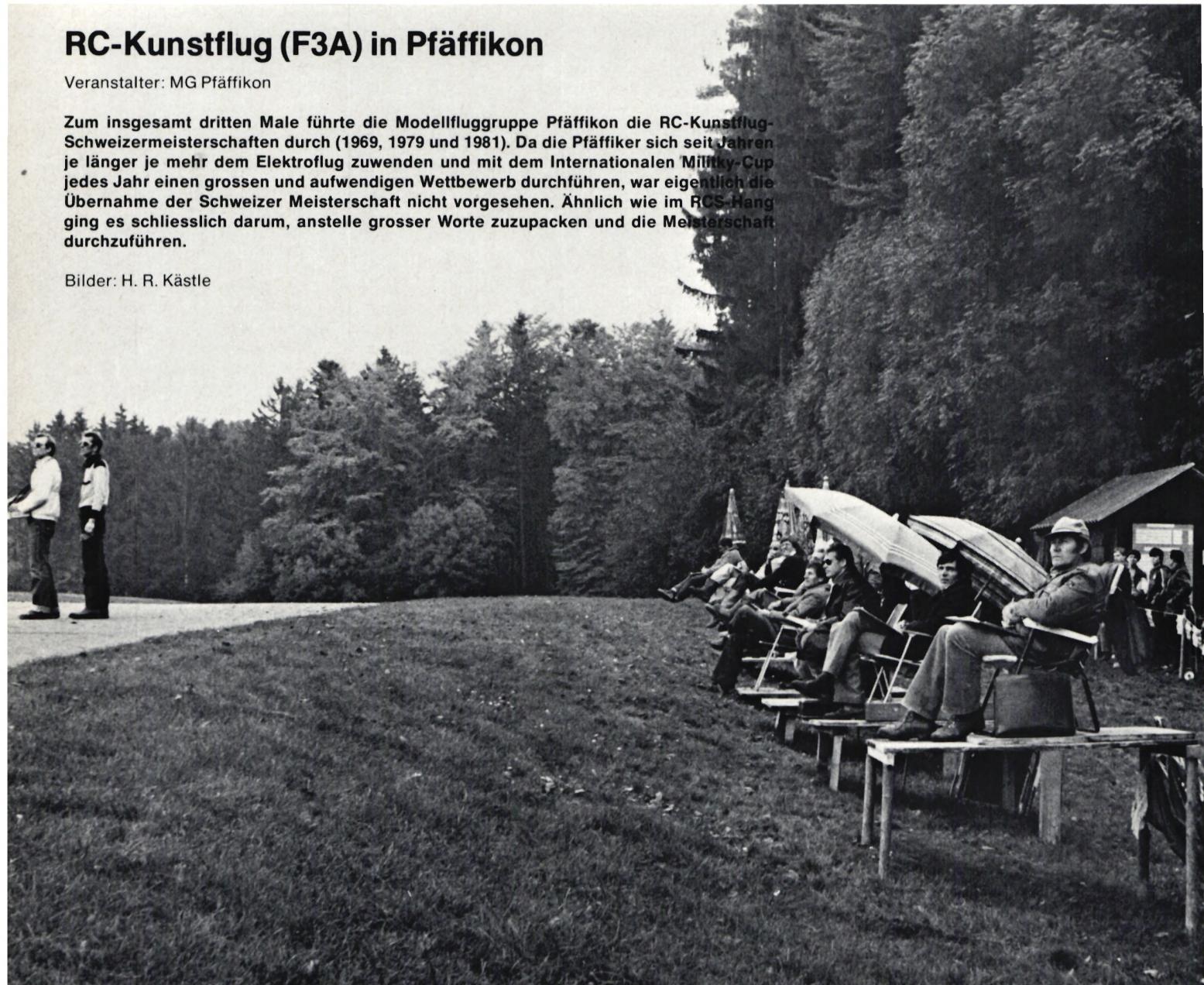
The figure program was established by the RC-Fako in 1980 and must be considered quite challenging. In December 1980, the CIAM (FAI) decided to allow each pilot to select their own program (as had previously been the case in the finals) and to remove takeoff and landing from the program. In practice, however, this freestyle program has proven to be problematic, since pilots fly different maneuvers and cannot really be compared with one another. Opinions are also divided on whether takeoff and landing should be removed from the program... “Flying means landing,” I once heard someone say—well, in aerobatics, at least, that would no longer be true. For Switzerland, the Fako had not decided on any changes for 1981, so the fixed program had to be flown once again.
One thing is certain: today’s flying style and high speeds will soon be a thing of the past. Nor will the shift toward larger models be the ultimate solution. Larger models require more powerful and larger engines, which would be at odds with noise abatement efforts.
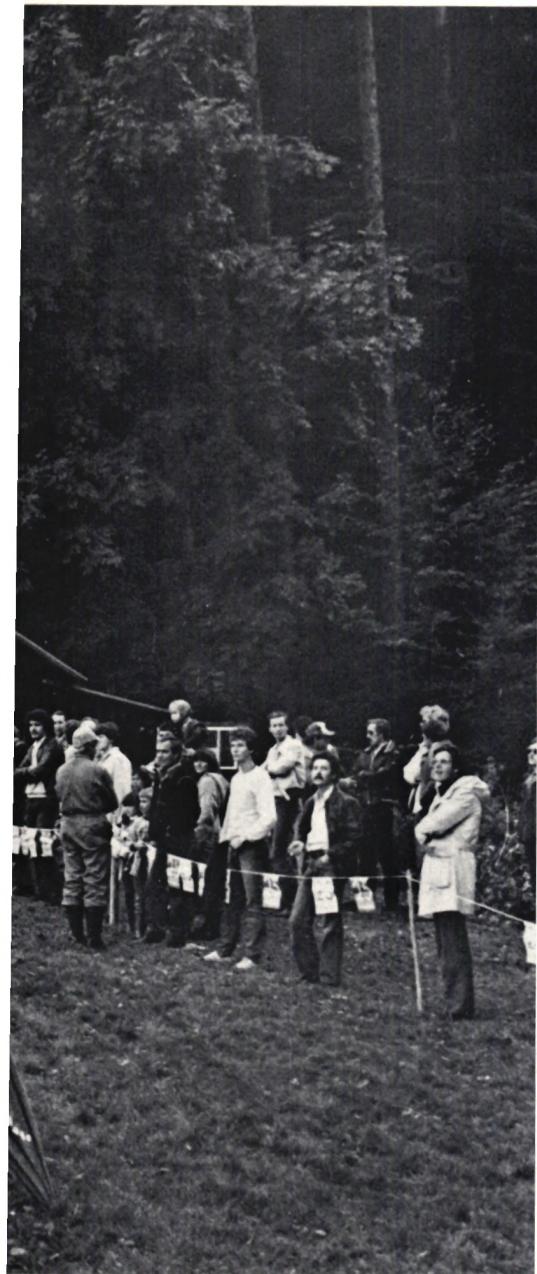
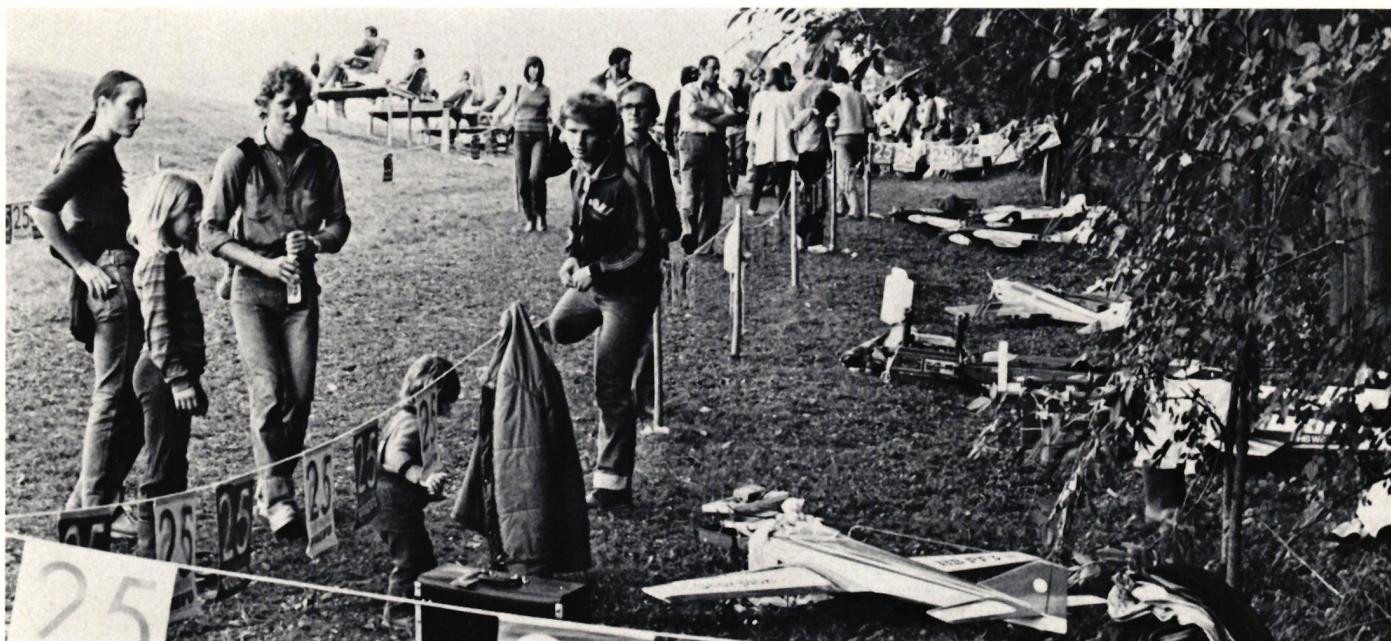
The call for entries clearly stated that all equipment must bear the type-approval number and that only the model remote-control frequencies approved by the PTT are permitted. There is little more that committees and organizers can do, even in the future. If a pilot intends to compete in a championship, then, as is well known, he must prepare. In my opinion, these preparations also include a thorough study of the relevant regulations as well as the competition announcement. It was almost predictable that the type approval number would still not be accepted everywhere. However, if a pilot specifies an official channel while simultaneously flying on a French frequency, this should actually be of greater concern to the PTT—especially if laws and regulations hold the same weight within its own ranks as they do for “ordinary” model aviators.
It seems to me that some pilots keep a particularly close and suspicious eye on the organizers, officials, judges, etc., but don’t care one bit about regulations and rules themselves. A lot will have to change in the coming years if we model aviators want to be taken seriously as athletes.
Overall, the level of flying in RC aerobatics has continued to improve in recent years. The field of top-level competitors has clearly broadened. However, given today’s high international standards, there is still much work to be done. Personally, I believe that most pilots still fly with too much “force,” thereby subjecting their aircraft more to the laws of ballistics than to those of lift-generating surfaces. I’m also increasingly bothered by the rampant use of “fräserei,” which in large-scale aerobatics now only really allows for comparisons to fighter jet formations. One of the main reasons that likely led to the development of very fast and stable aerobatic models is certainly the typically gusty Swiss weather. Fast models react far less strongly to turbulent air currents than slow ones. In steady winds, such as those found on the plains or near the sea, flight speeds could be significantly reduced without any drawbacks. Swiss aerobatic models have thus essentially become “bad-weather” aircraft: extremely overpowered, with wings that are too small and, consequently, excessively high wing loading. Should the weather happen to be nice and calm, hardly anyone is capable of performing true aerobatics in the classic sense anymore, and only a few judges would be able to evaluate such aerobatics correctly. Long live aerobatics.
Giez.
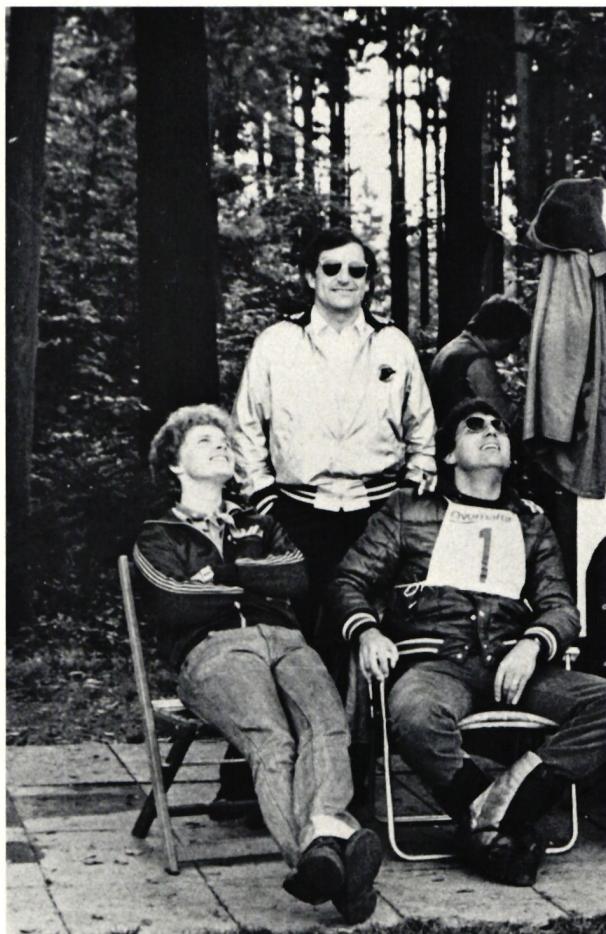
Once again, the pilots had to bring their model aircraft in for noise measurements. Although the AeCS’s efforts to reduce the noise level of model aircraft have, on the whole, been successful, the measurements left all the officials involved with an uneasy feeling. Engines that reach a good 14,000 rpm in the air barely hit 13,000 rpm on the test stand. This quickly raises the question of the usefulness and credibility of such measurements. Regional measurement protocols would require meticulous model inspection, which would entail more effort than the measurement itself. The FAI measurement method offers a small ray of hope, as it involves measuring each model from a distance of one meter at takeoff. While this short measurement distance is controversial among some experts, it proved quite effective at the 1981 F3A World Championships and can be carried out with virtually no loss of time. The unquestionably most accurate measurements—though technically complex—would undoubtedly be those taken during flight. For this purpose, the measuring device would need to be equipped with a recording mechanism, and the data could be evaluated at leisure after each run.
| Name | Group | Model | Motor | Propeller | Dimensions | RC System | Points |
|---|---|---|---|---|---|---|---|
| 1. Bruno Giezendanner | Pfäffikon | Scorpion | OS VF | Metterhausen | 10x 7 1/2 | Pro Line | 7387 |
| 2. René Schumacher | Visp | Arrow | Webra | Homemade | Simprop | 7093 | |
| 3. Emil Giezendanner | Pfäffikon | Scorpion | OS VF | Metterhausen | 10x 7 1/2 | Pro Line | 6735 |
| 4. Hugo Peyer | Reus Valley | Marvin | Webra | Metterhausen | 10 × 7 | Kraft | 6595 |
| 5. Noldi Peyer | Reusstal | Marvin | Webra | Metterhausen | 10 × 8 | Webra | 6476 |
| 6. Kurt Schyder | Falknis | E. K. | Rossi | Metterhausen | 10 × 8 | Graupner | 6197 |
| 7. Alex Meier | Wohlen | Scorpion | OS VF | Metterhausen | 10x 7 1/2 | Pro Line | 6065 |
| 8. Hans Lustenberger | Einsiedeln | Marvin | Webra | Metterhausen | 10 × 7 1/2 | Graupner | 5908 |
| 9. Markus Lehmann | Wangen | Marvin | Webra | Metterhausen | Simprop | 5814 | |
| 10. Philippe Prongin | Bulle | Griffon | OS VF | Metterhausen | Graupner | 5739 | |
| 11. Peter Mast | Rohrbach | Martello | OS VF | Metterhausen | 10 × 7 1/2 | Microprop | 5724 |
| 12. Christof Zubler | Munich Lake | Scorpion | Pro Line | 5703 |


News from HEBU

HORIZON HOBBY/LEMACO NEWS: MICRO OV-10 BRONCO 645 MM BY E-FLITE

PRIDE AND GOOD IDEAS
 Markus Nussbaumer

TEAM MANAGER "THIS" BOSSHARD
 Rodito Nussbaumer

YOU KNOW WHAT I MEAN? 125 YEARS OF THE SWISS AERO CLUB
 Emil Giezendanner

F3A EUROPEAN CHAMPIONSHIPS IN ST-MACAIRE, FRANCE
 Matthias Bosshard

ATOM, THE NEW DOUBLE-DECKER FROM CPLR
Matthias Bosshard
SUMMER FUN 2026 AT MG USTER
Martin Wunderli
What's New at Leomotion.com

52. 2026 ALPS CUP
Emil Giezendanner
TWIN TOWN PARTNERSHIP
Wolfgang Voeller
34th HAHNENMOOS ALPINE MODEL AIRPLANE CAMP
Res Dauwalder
CORSAIR F4U – A WARBIRD WITH A MEMORABLE LOOK
Jürgen Rosenberger, Jürgen Prinz
SMALL, MODEL-LIKE SAILBOATS
Res Dauwalder
TRY-OUT DAY AT MFV WETTINGEN
Urs Keller
WELCOME, NEW MEMBER!
Andrea Bolliger
FREE FLIGHT IN THE MIDDLE OF SUMMER
Urs Muntwyler
COUPE DES ALPES – OBSERVE AND LEARN
Rodito Nussbaumer
EURO CONTEST GLIDER ACRO TOUR AUSTRIA 2026

BY YOUTH, FOR YOUTH
Lorena Betschen
INSIGHTS INTO THE HISTORY OF SEAPLANES

THE PC-21 STORY
Emil Giezendanner
NEWS FROM HEBU
 Julia Bucher

FROM 0 TO 100
Markus Nussbaumer
MEMORIES
Wolfgang Völler
NOS REGION – A HUB FOR ELECTRIC AVIATION
Emil Giezendanner
DO YOU KNOW WHAT I MEAN IN THE LAND OF SMILES?
Emil Giezendanner
Have you almost forgotten about aircraft that take off and land vertically?
Emil Giezendanner